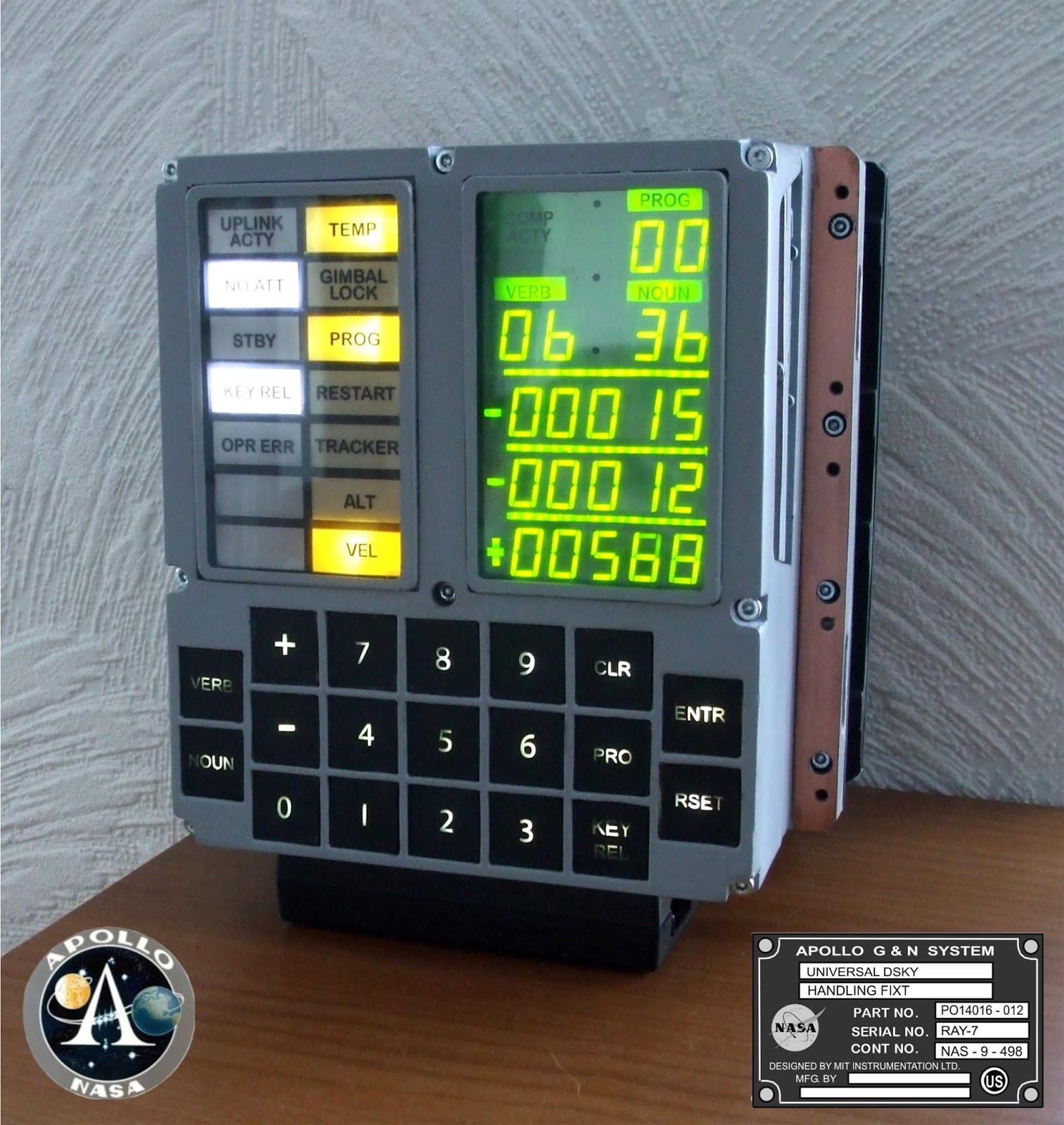
This is one of those ones in which a complete dumbass like me just loves the basic design, then tries to scramble to figure out more context and info, lol. Oh man, I would LOVE it if someone more knowledgeable than a bumbling doofus could add some notes, please?
That said, here we go! XD
The Apollo Guidance Computer (AGC) is a digital computer produced for the Apollo program that was installed on board each Apollo command module (CM) and Apollo Lunar Module (LM). The AGC provided computation and electronic interfaces for guidance, navigation, and control of the spacecraft.[3] The AGC was the first computer based on silicon integrated circuits (ICs).[4][5] The computer’s performance was comparable to the first generation of home computers from the 1970s, such as the Kenbak-1, Apple II, TRS-80, and Commodore PET.[6] At around 1 cubic foot (28 litres) in size, the AGC held 4,100 IC packages.[5]

https://thumb.wikimedia.org/wikipedia/commons/thumb/7/79/Agc_view.jpg/500px-Agc_view.jpg
The AGC has a 16-bit word length, with 15 data bits and one parity bit. Most of the software on the AGC is stored in a special read-only memory known as core rope memory, fashioned by weaving wires through and around magnetic cores, though a small amount of read/write core memory is available.
Astronauts communicated with the AGC using a numeric display and keyboard called the DSKY (for “display and keyboard”, pronounced /ˈdɪski/ DISS-kee). The AGC and its DSKY user interface were developed in the early 1960s for the Apollo program by the MIT Instrumentation Laboratory and first flew in 1966.[7] The onboard AGC systems were secondary, as NASA conducted primary navigation with mainframe computers in Houston.[8]
https://en.wikipedia.org/wiki/Apollo_Guidance_Computer

“While much of the Apollo computer used transistors, the DSKY still used relay switches, which is why it makes a satisfying clicking sound when it updates.”
Holy Hecubah, that’s… part of why I love my old electro-mechanical pinball machines. ❤️
Oh, and here’s a builder project, make your own, mate!
https://hackaday.io/project/186074-dsky
Very cool, thanks for sharing!
Apollo guidance computer restoration series! https://www.youtube.com/playlist?list=PL-_93BVApb59FWrLZfdlisi_x7-Ut_-w7
It is super interesting.
Came to check if CuriousMarc was mentioned in the comments, good job!
5 to 10 years ago I did a deep dive into how those computers worked. Mainly the odd command inputs. I doubt this is the article I read then, but this one I just found is a good start
Well worth the read, thank you. Delightfully geeky, but understandable.
Wow… that could make for a brilliant follow-up post here!!
❤️