
You must log in or register to comment.
If I built a distro I’d call it Buddha Linux so every time someone points out something good in general Linux discourse I could say “that’s exactly how Buddha Linux is” and every time someone points out something bad I’d say “that’s exactly how Buddha Linux is”. It’s infinite marketing. It’s the absence of marketing.
Maybe not exactly the same, but Bodhi Linux is an Ubuntu derivative that develops the Moksha desktop environment based on the Enlightenment window manager.
That’s exactly how Buddha Linux is.
My man walked right into the trap while watching you build it
There is no trap. Only a pause on your path.
According to some distros, source is reality. According to other distros, binary is reality. But the truth is in the middle way: binary and source are the same.
Compiling is just a construct! I could use Gentoo or flatpak and get the same product.
“It’s so great that Linux actually gives me control of my OS. I wish all OSs treated their users like intelligent people too. I’m gonna configure it to my exact specifications…annnd I broke everything.”
It’s not about knowing what stuff to touch, it’s about knowing what not to touch. -Buddha Linux
Breaking Linux just shows you what not to do next time.
Me, cursing at my lack of sound:
“Maybe I shouldn’t mess with my audio server config…”Me, finally having fixed it:
“I’ll fucking do it again”lmao for real. i’ve been so tempted to just get a system76 and be done with all that. randomly losing audio in the middle of doing anything is so obnoxious.
I haven’t had any issues with it since the last time fixing it. There’s a single app (Steam) that forgets its audio settings on reboot and every update replaces the launch script I use to help it remember, but even so, it runs perfectly well.
It’s just that every time I do decide to mess with it, I end up with a silent reminder that I have no idea what I’m doing. Then I tinker some more and it starts working again and stays stable so apparently it’s correct now and I’m not sure I understand why. So I decide to leave it be, until the urge to try something new becomes overwhelming…
“Never touch a running system” is for cowards. And reasonable people, I guess. I suppose I’m neither.
Running on Dell XPS, Lenovo T-Series and Asus laptops absolutely 0 problems with audio… except Slack.
Boss: let’s huddle
Me: OK! preferences > audio and video, webcam works, mic showing me talking!!! Join Huddle!
Boss: I can’t hear you.
Me: preferences > audio and video , microphone no longer exists.
pkill slack
slack &
restart huddle, it’s fine.
But, to be fair, he’s on windows and 1/10 times he can’t be heard.
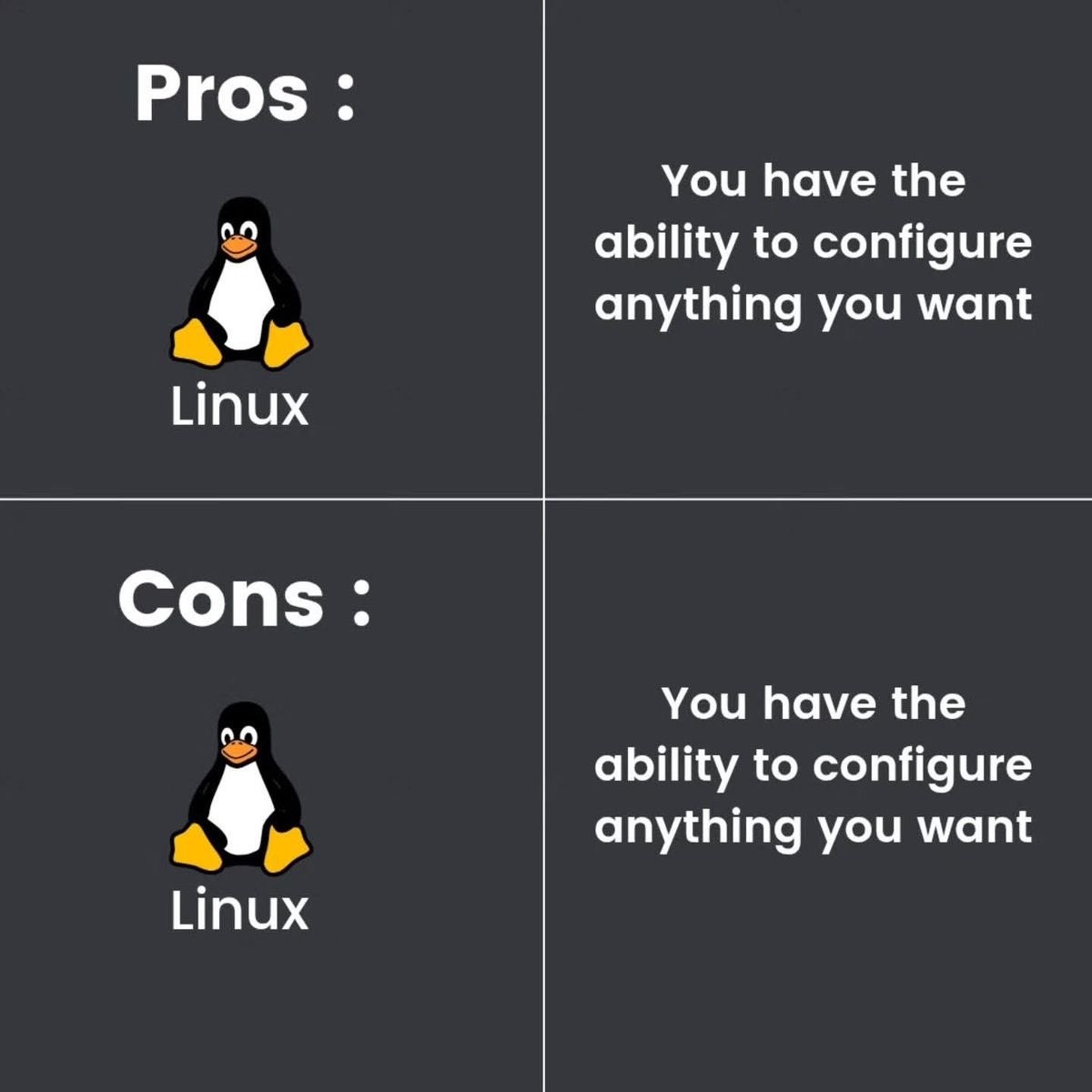
The con is more like:
You must configure something you never wanted to know anything about, but I guess today is a learning day…again…
deleted by creator
You have the ability to break anything. Your distro, maintainers, developers also like to break things from time to time.
Don’t blame yourself for others breaking things.
Vibe coding nixos to combine kde and gnome on an ext2 raid with snapshots
This is unironically why I switched over to Bazzite, and why I recommend it to newbies as well.
I will tinker too much and break things.
At least with Bazzite, if I thinker too much in a container, I just throw out the container and try again.
(And if you insist on fucking up the core OS, presuming at least some of it is still intact, you can rollback/reinstall/rebase fairly easily)
Bazzite was too limiting for me and the layered updates made updating take forever. I was only using it on a media PC at the time too, so it wasn’t as if I had that many changes.
I’m perfectly happy with CachyOS. Can basically do whatever I want and snapshots are a nice safety net. Updates take like 2-5 minutes depending on how long it’s been since the last time I ran updates and the power of the system (Steamdeck always takes longer than my desktop or media PC).
Hey I mean, if Cachy works for you, that’s awesome!
I’ve not tried it yet myself, but I’m not gonna be like an insane hyper fan boy for Bazzite.
I will fully admit to just having had toooo many insane experiences trying to get Arch to do what I wanna do… kinda sucks to have to rely on the AUR for random dependencies for something like building a whole game engine from source.
But, my use case is not your use case, I’m geneuinely glad you’re happy with what works for you.
One of the goals of Cachy is to take the pain out of Arch. I’d tried to use various Arch flavors before and I just never had a good experience. Vanilla I had no patience for, Manjaro is known to break more than vanilla with updates (something that happened to me), and Endevor just didn’t feel right for some reason.
Arch purists aren’t happy about that because it goes against the “ethos” of arch, but they don’t seem to like when a distro comes with a desktop environment.
Cachy has been pretty painless and I’ve been running it on multiple machines. There are regressions that sometimes happen since it’s still arch and gets the latest updates, but that stuff is usually quickly fixed or rolled back if there is a bigger issue that needs more time to fix.
The only real issue I had was it revealed a hardware problem with the newer Ryzen CPUs getting unstable in the new lower power CState 6 when idle. Disabling the CState fixed the issue.
Change “ability” to “necessity”
Except on Linux Mint, where it asks if I want the usual, and I click “Yes.”
That’s why I’m making exactly 0 (Zero) modifications to my Mint install. Win win!
Post title (on Lemmy, mind you) inspired by using the nuclear option in the game Lemmings?
Unintentional, but that’s funny. I think I played a Lemmings demo sometime back in the 90s, but not enough to remember any specifics.
I used to make a game out of seeing how much of the map I could destroy by nuking my lemmings.
Responsbility’s double edged sword