The South Korean artificial sun, which goes by the name KSTAR (Korea Superconducting Tokamak Advanced Research), has made an important scientific discovery concerning nuclear fusion by being able to sustain plasma in high-confinement mode for a period of 102 seconds while simultaneously managing to keep plasma temperature at 100 million degrees centigrade for 48 seconds. This development by the Korea Institute of Fusion Energy (KFE) is another move towards achieving clean fusion energy, whose ability to generate unlimited amounts of electricity with little to no carbon emission is promising.


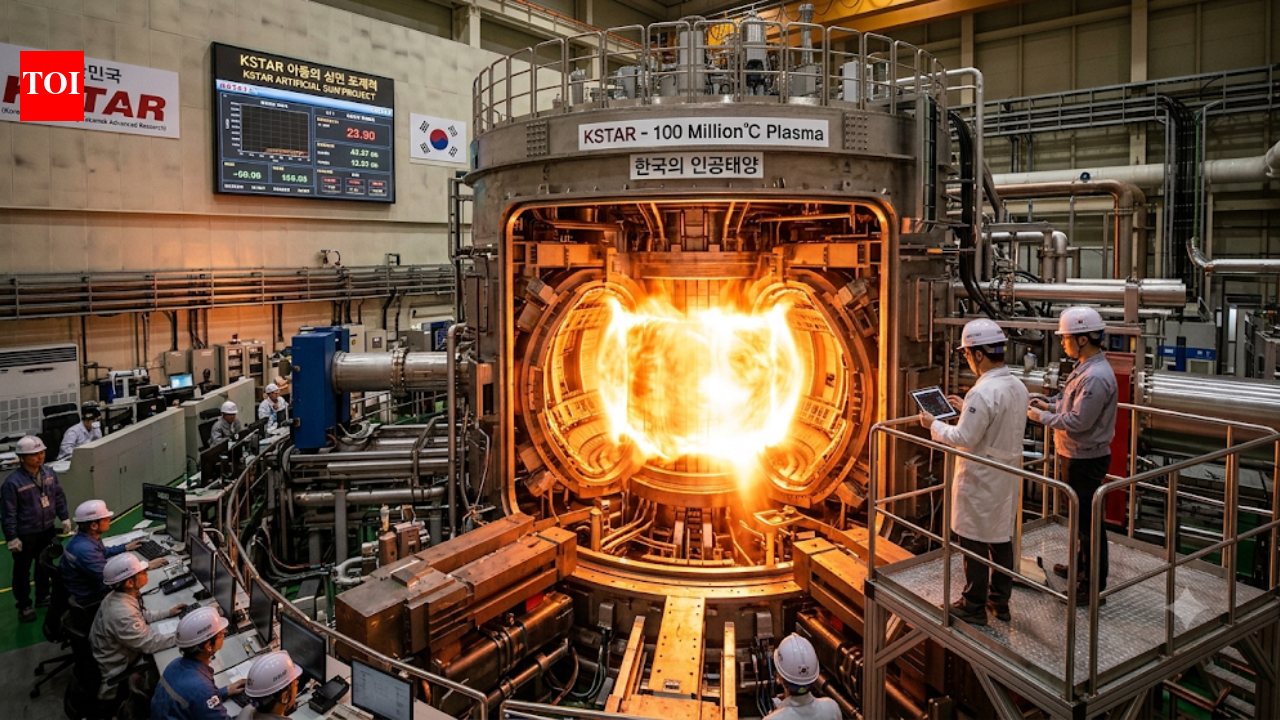
You can just say fusion reactor
The article, like so many others concerning nuclear technology, refused to address the unit cost of energy.
Why is building a large, complex, and temperamental fusion engine more economical than churning out an equivalent number of wind turbines or solar panels? The article doesn’t say
For the same reason someone would have asked “why is building a large, complex and hard to produce solar panel more economical than churning out an equivalent number of coal plants?” decades ago.
It’s improving the tech, which could eventually far and away outpaced every other energy producer. Maybe not now, but in the future. Some are just gung-ho about trying to produce a bunch when they’re not quite ready.
Why would you create another source of heat instead of harnessing incoming one? Also your comparison is a little bit off. This tech will be large, complex, hard to produce compared to solar just because of its nature.
Solar engines have historically been simple and easy to produce relative to coal and gas engines. We’ve had industrial solar heating technology since the 19th century, even. Sort of the joke of fossil fuel technology, in that it’s been a consequence of heavy R&D investment and industrial build out as much by choice as by any engineering advantage.
It’s been a pop science empty promise for decades. We were talking about fusion technology in the 1960s like it was just around the corner. Yes, there’s an enormous amount of output in fusion technology. But it requires even more energy input. What’s more - as the article downplays but is forced to concede - it is highly unstable and difficult to sustain, even at a super-sized laboratory setting.
This is a far cry from fission which can be achieved practically by accident (see the Chicago Pile-1) and is comparatively straightforward to control via mechanical methods.
Even in the event you manage to produce something approaching stable fusion at the size-scale necessary for industrial deployment, there’s still no reason to believe the technology would be cheaper per watt than the indirect capture of an already running supermassive fusion system (ie, the Sun). In that case, it wouldn’t outpace every other energy producer for the same reason conventional nuclear power hasn’t.
Meanwhile solar and wind have been funded generously for decades but still can’t get us free of fossile fuels.
Wind and solar overtake fossil fuels in EU power supply
The Times of India is a rag that literally accepts bribes for positive coverage; sensationalist garbage is their bread and butter.
But it gets worse: this story is over two years out-of-date.
This happened back in 2024. Here’s a paper.
I remember reading about russian intelligence sponsored anti vaccine propaganda from the time of india, targeting poor countries like pakistan and in africa and the like.
It doesn’t.
Fusion isn’t as bad as fission or fossil fuel. If they can get it to work. The reactor needs to run continuously (for days) and the energy output needs to be positive. Then it would have a huge impact.
Every energy source as its drawbacks. I.e. Solar panels and wind have the recycling of compound materials issue - it’s all glued together. And the environmental impact of source materials production, i.e. neodymium. Mining, refining,…
Some are worse than others. But none is or will be impact free in terms of sustainability or environmental destruction.
To date, terrestrial fusion has been a net-negative energy system. That’s strictly worse than fission or fossil.
Do you think we’re getting terrestrial fusion without mining or materials compositing? What do you think fusion reactors and their attendant facilities are made out of?
We’re getting into reactionary FUD about wind turbines when we start waxing poetic about the environmental impact of big fan blades and dynamos (which are just as critical for coal and gas plants, btw). At some point, you’re still just converting mechanical energy to electrical energy, no matter what system you’re proposing. All of that will require industrial metals and conductors.
Is this a bot? These can’t be real responses…
People want to vote for trump a 3rd time. It’s definitely possible those are real responses.
My mistake. I did not specify in what regard. I had the waste in mind. Fusion waste is radioactive for a few decades. Fuel wise, there is an abundance of Deuterium, like a gram of it in every bucket of ocean water give or take. Tritium? That’s the harder part.
You are right. It doesn’t work yet. And it will be too late to solve the current energy crisis. If they get it working at all. But I see no harm in trying.
Your remaining statements: I did not intend to say that solar and wind power are bad, but they are not flawless (again: sustainability and sourcing).
Because there’s currently only one place that should theoretically be able to create one that works at scale to become energy positive, thanks to a novel way of making the electromagnets used to contain the plasma under enough pressure. As per usual, a beneficial reactor tech is still “five years out”. We do keep inching closer though.
Wind and solar can’t get us free of CO2 yet.
Wind and solar overtake fossil fuels in EU power supply