

You must log in or # to comment.
tl;dr A network operator can perform a MitM attack on the built-in updater’s call-out checking for updates by faking the Notepad++ update website, telling it a new version is available at <malware URL> and then downloading and running the malware
It requires a malicious network operator, or preexisting malware on the host.
https://notepad-plus-plus.org/news/v889-released/
Since you have to opt into tracking to read the article (which I think is illegal) here’s the source.
One of the few moments safari is the easier option…
-tap hide distracting items -tap the bullshit banner -it blows away dramatically
ublock has the same function; it’s the thunderbolt icon, which let’s you just zap away whatever html element offends you!
…no fancy animation tho…is there a plugin that animates the ublock zapper? that would be very fun!
we share data with our 188 partners
That’s a no from me dawg
The updater integrated into Notepad++ has allowed itself to be infiltrated by malware, which has been installed on some PCs. The developer of the powerful open-source text editor is responding with an update to Notepad++ v8.8.9. Users currently have to perform the update manually.
In a news post on the Notepad++ website, developer Don Ho explains that “some security experts have reported incidents where internet traffic affecting Notepad++ was intercepted.” According to the post, investigations have revealed that traffic from the Notepad++ updater WinGUp “was occasionally redirected to malicious servers, leading to the download of compromised executable files.” IT security researcher Kevin Beaumont reports that at least three organizations “with interests in South Asia” have been targeted in this way.
As Beaumont explains, the updater uses a version check that queries the URL “https://notepad-plus-plus.org/update/getDownloadUrl.php” and evaluates an XML file delivered through it. The updater uses the download URL listed in the XML file, saves the file in the %TEMP% folder, and executes it. Anyone who can intercept and manipulate this traffic can therefore change the download URL. Until version 8.8.7 of Notepad++, the developer used a self-signed certificate, which is available in the Github source code. This made it possible to create manipulated updates and push them onto victims. Since v8.8.7, however, Notepad++ relies on a legitimate GlobalSign certificate, and installing its own Notepad++ root certificate is no longer necessary.
Remedy through updates
With Notepad++ v8.8.8, the WinGUp updater now forces github.com as the download source. Version 8.8.9, released overnight on Wednesday, further hardens Notepad++ and WinGUp so that they correctly check the signature and certificates of downloaded installers during the update process. If the check fails, the update process is aborted. Don Ho notes that investigations are ongoing to determine how the traffic hijacking occurred in the observed cases.
Kevin Beaumont also lists some indicators of compromise (IOCs). For example, connections from “gup.exe” to URLs other than “notepad-plus-plus.org”, “github.com”, and “release-assets.githubusercontent.com” are suspicious. Likewise, attention should be paid if “gup.exe” starts unusual processes – only “explorer.exe” and “npp*” related Notepad++ installers should run under it, which since versions 8.8.8 are also signed with a GlobalSign certificate. After the observed attacks, files named “update.exe” or “AutoUpdater.exe” (Notepad++ itself does not use these names at all) were apparently also found in the user’s TEMP directory, from which “gup.exe” downloaded and executed the updaters.
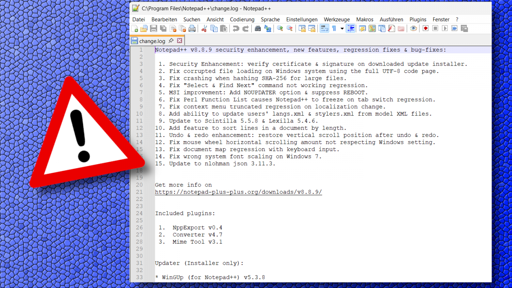
Notepad++ v8.8.8 currently does not find the update.
Beaumont recommends updating to at least Notepad++ v8.8.8. However, version 8.8.9 is even further hardened. The integrated updater from Notepad++ v8.8.8 does not yet find the update, and “winget” also does not currently find a newer software version. However, the latest version is available as a manual download on the Notepad++ website.
Notepad++ is frequently targeted by malicious actors because the software is popular and widely used. Last year, for example, Don Ho asked for help to get rid of a “parasitic website” that was creeping into the original Notepad++ site in Google search results. It had unscrupulous intentions. In general, fake sites often appear in search results offering virus-infected files.
(dmk)
This article was originally published inGerman. It was translated with technical assistance and editorially reviewed before publication.
Don’t whine about data sharing, just open it in a non-javascript browser. Perfectly readable.
Yeah, don’t complain about shitty things, just work around them.
This is a tech sub. People should be capable to know their shit around these well known annoyances. Now imagine US sites that have much fewer regulations. Don’t you ever again browse, or do you just click on ‘accept all’?
It sucks that it’s impossible to complain about things and work around them. Sadly we’re trapped 😔
Just because someone is tech knowledgeable, doesn’t mean they know everything about tech.
Mate you’re the only one whining. I got around the cookie banner just fine, and reposted here for others.
OP, if people have to do the work for you in posting sources, consider this a learning lesson as to what not to do.
Until version 8.8.7 of Notepad++, the developer used a self-signed certificate, which is available in the Github source code. This made it possible to create manipulated updates and push them onto victims, as binaries signed this way cause a warning „Unknown Publisher“. Since v8.8.7, however, Notepad++ relies on a legitimate GlobalSign certificate, and installing its own Notepad++ root certificate is no longer necessary – if such a warning pops up, users should be alarmed.
I don’t understand how this is relevant. Unless the attacker has either
(a) somehow acquired the private key of the cert
(b) replaced the cert delivered through the installer
A self signed cert isn’t any worse. Both of these attack vectors still work with a public root CA. Or maybe notepad++ just forgot to validate the self signed cert against the one they delivered through their sources, just accepting any non-expired cert? That’s just a bug.
I don’t get how this was exploited in practise.
Even if the signatures on the downloaded packages weren’t checked properly, how would you modify the content of the XML file returned from https://notepad-plus-plus.org/update/getDownloadUrl.php?version=8.8.0 ? For that you’d have to break or MITM the TLS too, no?
The usual case for TLS MITM is when a company decides DPI is more important than E2E encryption and they terminate all TLS on the firewall, but if the firewall is compromised there would be much easier avenues of entry other than notepad++
Maybe it was used as some sort of privilege escalation? E.g. NP++ downloads an XML file to %TEMP%, some already present malware modifies it, then GUP downloads a payload and executes it with administrator permissions.
Not accessible without accepting advertising cookies, like Healthline.
It’s a bit concerning that neither the article or Notepad++s blog post say what the affected version is, or what the minimum safe version is.
I’m assuming the minimum version is 8.8.7 since that’s when they moved away from self signed certs, but it would be nice to hear it from the horse’s mouth.
deleted by creator
god forbid a regular Joe doesn’t whip out the tinfoil whenever they take a note.
I commented on the wrong post. It was from c/leopardsatemyface!
I have it installed in Wine, I haven’t updated it in months though.
I just updated through Ninite and it went to 8.8.9.





](safari-reader://www.heise.de/imgs/18/4/9/9/3/6/1/8/2025-12-10-Notepad__-8.8.8-Updater_findet_kein_Update-8f3a2396ab56758a.png)