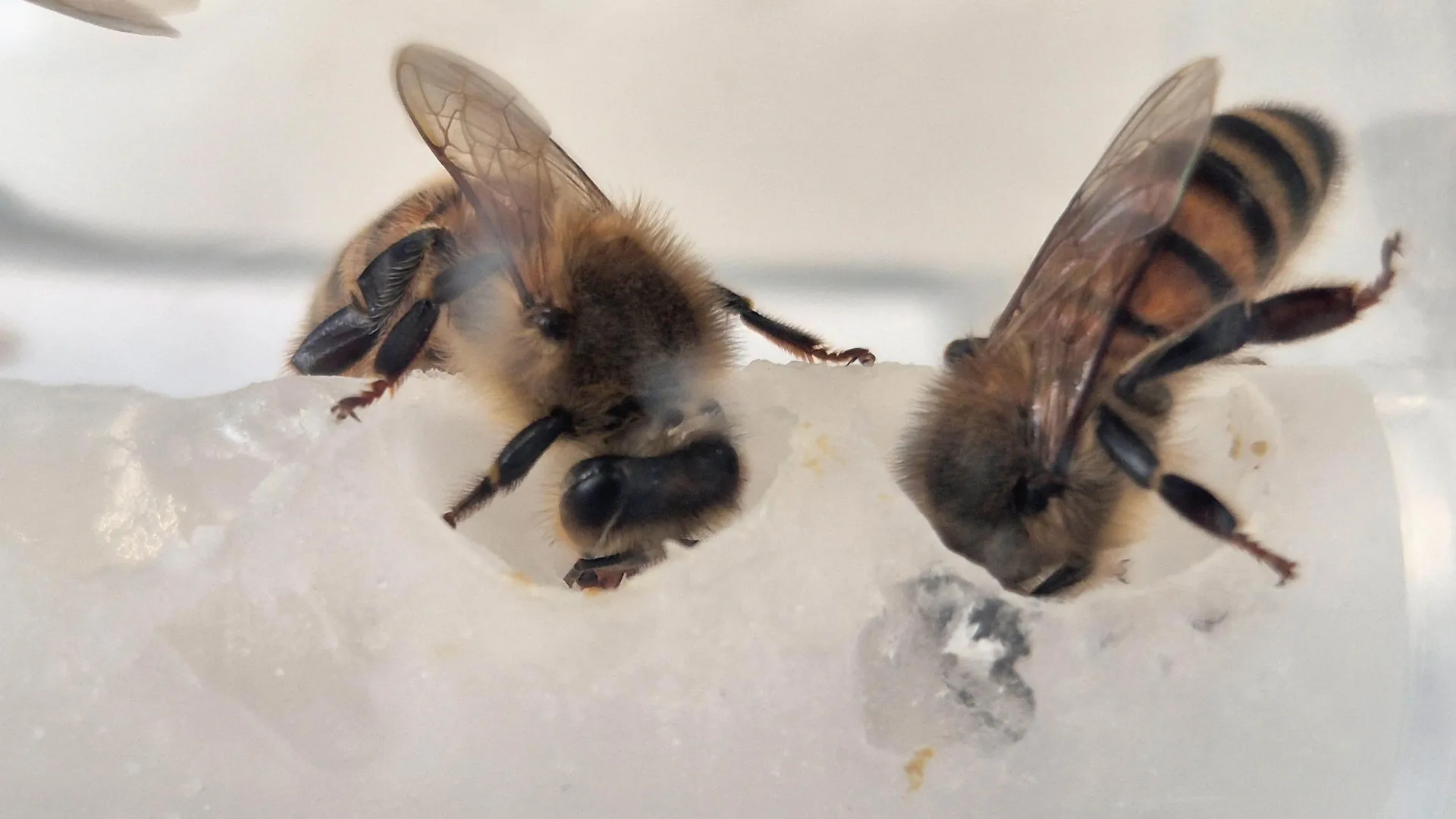
Using CRISPR-Cas9, scientists engineered a yeast to produce the nutrient feed. Farmers could have it in two years.
The solution is so simple. Crop/pollen diversity. Instead of letting fields lay fallow for crop rotation, they could plant diverse wildflower meadows to improve quality of bee health for the traveling bees that get shipped around for crop rotation. Or the bee keepers themselves that sell the services of their bees, could ensure diverse flower and pollen options when their bees aren’t traveling.
Instead of letting fields lay fallow for crop rotation, they could plant diverse wildflower meadows to improve quality of bee health for the traveling bees that get shipped around for crop rotation.
I can see a potential problem with this suggestion. How many of those wildflowers are net nitrogen fixers? If they are net-negative this approach could be draining all the nitrogen out of the soil during off-rotation years meaning large amounts of petrochemical fertilizer would have to be used to make the field productive again for nitrogen consuming crops (like wheat and corn).
Key Native Nitrogen-Fixing Wildflowers:
- Lupines (Lupinus spp.): Includes Texas Bluebonnet and various perennial species; they thrive in poor soil and are loved by pollinators.
- Prairie Clover (Dalea spp.): Purple (Dalea purpurea) and White (Dalea candida) are drought-tolerant perennials that fix high levels of nitrogen.
- False Indigo (Baptisia spp.): Sturdy perennials with showy, pea-like flower spikes (e.g., Blue False Indigo).
- Partridge Pea (Chamaecrista fasciculata): An annual that grows rapidly, making it excellent for disturbed soils.
- Wild Senna (Senna hebecarpa): A tall perennial that produces yellow flowers.
- Canada Milkvetch (Astragalus canadensis): A hardy, native perennial.
- Groundnut (Apios americana): A vine-like wildflower with edible tubers.
https://edgeofthewoodsnursery.com/wp-content/uploads/Native-Plants-for-Nitrogen-Fixation.pdf
Cheers
Several of those are going to be perennial and end up competing with mono-culture crops the following year(s) (not that I’m trying to defend mono-culture crops, but that’s what they’re planting). It’s a good idea, but not necessarily as simple as you’re implying. Still it’s an idea that’s not without some merit. The biggest obstacle to adoption is no one is making a significant profit off of it, so it’s unlikely to see much uptake.
You aren’t wrong, but soil can be turned over, and the wildflowers can be removed.
What about the seeds they dropped the year prior
I don’t mean to argue against flowers, but why specifically Pennsylvania? What about everywhere else?
I’m sure things are different in different parts of the world, but where I’m from, pretty much none of the big crop farms let fields lay truly fallow. Most of them plant various cold season cover crops that include things like clover, brassicas, and legumes like vetch. Those all produce lots of flowers that feed the bees in the off season.
The issue with wildflower meadows, and correct me if I’m wrong, is that most of those wildflowers bloom at times when the fields would otherwise be needed for crop production. Of course, there are farmers who skip planting at all some years, but in my neck of the woods, nobody does that. They plant every year, at least once, they just rotate different crops in and out. Corn one year. Hay then soy, the next. And so on.
Bee extinction means no polination, no polination means no crops; penny wise and pound foolish.
Bee extinction means drastically fewer crops and less pollination, but not no crops. It would be devastating, but there would still be agriculture. Lots of staple crops are wind pollinated and don’t rely on insects at all. But for the rest of our food, that would all become very expensive and widely unavailable.
I learned during COVID about planting diverse local wildflowers to help with pollination in my small little garden I used to have. I ended up dedicating like an 8x6 planter just for wildflowers every year. Always had tons of bees, hummingbirds, and butterflies. I honestly never realized how many species of bees there were. The first year I did it I tripled my veggie yield, never looked back.
True but at the same time bees help spread pollinating plants - it’s a two way relationship. They may be commercialised for crops, but they will go to any plants in range and contribute to their spread.
So a method of increasing bee populations may also be helpful in spreading wildflowers and speeding up rewilding efforts.
In addition dramatically increasing bee populations may help resolve issues with pollination such as in some regions of China where damage is so bad that hand pollination is needed for crops. Restoring bee pollinators in those areas may increase crop yields, which in turn reduces the general pressure globally on expanding the use of fertile land for farming.
So while crop/pollen diversity is certainly very important, this kind of research still has potentially big benefits for the environment both in the fight to rewild and slow the spread of land use being moved to farming.
Works for me. I only mow early spring and early autumn. During spring and summer the yard runs on it’s own. Every year is different. Each year it looks different. Every year honey tast little different. But … that is how it’s supposed to be!
“brands” hate that, taste must be 100% predictable year to year. Just like wine. Grapes are different each year too. Imagine the amount of additives required to adjust (read that as ruin) the original flavor.
Don’t worry. Dust bowl 2 comming in hot to teach this lesson the hard way.
nah man. bees just crave brawndo.
Several bee factions see this as a vaccine and are opting out. /s
Bee Joe Rogan is going hard on ivermectin
So they solved a problem we create ourselves, by destroying nature, by making a product that now increases the cost of food and makes farmers even more dependent on corporate chemical companies to grow it.
Yep, you can’t charge money in perpetuity if you solve the actual problem. Not only that, but bees will eventually become reliant on the product. This is how the US Healthcare system works as well.
Hell they might even genetically engineer them to be dependent on it.
Jem’Hadar bees, wonderful /s
I bet the bastards have already wondered
"Hmm, if this works maybe we can do all life on earth next . . ?
“We’ll make all the money!”
Thats also how fertillizer works. Honey Bees are domestic Animals and require care to be usefull to us.
Monsanto and Archer Daniels Midland will be demanding a percentage of the farmer’s crop because they saved the bees that pollinated it.
Yes but you see, now the solution is a product, and shareholders shall profit from its sale. Value where no value was before. Blessed be the capitalists.
And so the house of cards grows by another level. We’ll just modify this to add this missing thing. Never mind why it is missing. 10 years later we are 9 layers deep on plugging holes we’ve created that technological advancements got us out if until they don’t and whoosh the cards come crashing down. The hardiness of nature replaced by the frivolity of man.
I really wouldn’t call nature “hardy” when an entire ecosystem can collapse when you can take one single species out of it
Let’s remember that nature is what produced pandas
Though I still agree
Nature is extremely resilient and adaptable. Life has survived entire mass extinctions and come back flourishing
Sure, nature writ large is resilient and adaptable.
Individual species die off all the time. Sometimes for stupid reasons.
What ecosystem collapses when removing a single creature? Are you talking about pre-holoscene extinction ecosystems? Or are you talking about modern ecosystems (after most of the original biodiversity has already been obliterated, and “removing one species” is actually thousands down on the list of removals)?
Fair enough. It was meant yo contrast with man’s obviously fragile solutioning on the fly.
Something like this already happened when we traded the long-term health and fertility of the topsoil for the immediate high yield output of artificially fertilized crops.
By outsourcing the repleneshment of fertility to the relatively fragile and unreliable supply chains and social organisations of man, we assumed management over a delicate balance which previously belonged to nature.
I’m not arguing against industrial agriculture and its commodification of fertiliser by the way. If carefully managed it’s possible to imagine an endpoint of equilibrium where global supply chains increase total system fertility by selectively resting soil and relying more on imports to then switch once local fertility peaks and so on. Really just sane and unmolested market forces should in theory discover such a negotiated endpoint.
Fertility alone is not descriptive enough to capture, say, the importance of biological diversity or the load bearing capacity of local environments to support ecosystems, while also producing exportable outputs suitable for maintaining population growth in humanity.
Perennial crops are also ridiculously underused in overall food supply chains. They are more difficult to monetize in existing commodity forms because their overall system value is not captured numerically.
I don’t have an overall solution, but any solution will require at its core a way to assign value to the work which nature already does to replenish its own local fertility and to price that effect very cautiously in such a way that it becomes cheaper for intensive producers to rest unfertile soil until it becomes fertile than it is to compensate for unproductive soil by importing chemical fertiliser from somewhere else
Perennial plants don’t provide the same nutritional yields. Annuals put all their energy into making fruits/seeds that can be harvested. Things like potatoes or onions don’t put all their energy into seeds, but they do put a lot into their roots and that’s what’s harvested.
We need more biodiversity, but we can start by not having brain dead landscaping dictated by office suits.
Throughout history the human population has only been able to increase thanks to innovation. Irrigation, the wheel, alternating crops, crop distance, keeping disease in check, genetic engineering to increase resistance and crop yields, and this is another innovation in that line. If you want to go back to nature, by all means do.
I believe the only way forward is through science and innovation and if that means genetically altered food for the bees, then so be it. This with the in combination with limiting roundup should bring the global bee populations back from the brink.
You’re quickly glossing over all the issues.
“human population has only been able to increase thanks to innovation”: and that’s a good thing? What would be wrong with a more manageable human population?
“If you want to go back to nature, by all means do.”: how? The world has advanced beyond that, it’s clearly not an option.
“the only way forward is through science and innovation”: if science & innovation is what you call forward, then obviously yes, but that’s just a tautology. What is your measure of “forward”? If it’s power over nature, advancements, … then for sure. If it’s respecting this earth and not long term ruining the entire planet… how sure are you about that?
“limiting roundup”: ah, an innovation that should be limited. What went wrong that it was globally used before we were sure enough about its side effects? How sure are you about all the current innovations that they don’t have similar issues? How sure are you about this bee superfood not having disastrous long term effects?
If you ignore all the issues with it though, innovation is incredible for sure!
I would argue the right direction to go forward in is the direction where Billions of People dont starve. Innovation and sustainabillity are not mutually exclusive.
Current agricultural progress is mostly about needing as few people as possible for farming, not making enough food for everyone. It’s widely known there is plenty of food, the issues are social as to why some are still hungry, not technological.
And in the end, we’re on a finite planet, so whichever way you look at it, keeping increasing population numbers has to end somewhere, so the question is not does enough humans exist, but what is enough, and i think there are plenty of arguments thaht we’re overpopulating the earth already.
“Overpopulation” is fascist dogshit
Can you agree we can’t put an infinite amount of people on a finite planet?
So that by default the discussion is not if overpopulation can exist, but when we reached it? If you don’t feel we reached it yet, i can imagine that. It’s a very tough topic. But just the very basic facts of existing on a planet of finite size means that there can only be so many of us before everything collapses.
And which fascist things do you associate with the “overpopulation” topic (i imagine for example the one child policy in china?). It’s not because something has been used by fascism, that it’s inherently fascist.
Shortsighted reductionist viewpoint. Not science but philodophy will get us (all living beings!) out of the mess our global ecosystem is in. I do get the desire to ‘fix’ stuff, though. But it’s the wrong approach imho.
Also, managed woods.
Welcome to 8 billion people and growing.
Couldn’t agree more
Removed by mod
I’m interested in your opinion, but can you like maybe not just post a personal attack, and explain why you think what the guy you replied to is stupid?
From my experience, what he describes really reflects what we see happening in the world all the time. layers of layers of us causing issues, and then solving them with more technologies, creating new problems, etc… etc… etc…
And the big bet is that we’re not digging ourselves into a very deep hole. In the end, the existential threat of global warming is one of the examples. We kept solving problems with burning more & more burning of fossil fuels, and then suddenly “o crap”.
Removed by mod
Get rid of the large swaths of green fucking grass, which completely useless when one cuts it down. Let the Dandy Lions grow like we do in Europe and plant more native flowers too.
Clover. Clover is great:
- Lush and green
- Holds down soil we
- Soft to walk on
- Needs less water than grass
- Needs less mowing
- Bees love it
+1 for clover. I “accidentally” spilled some clover seed outside our place (bugger off HOA), and it’s slowly overtaking the grass they planted.
+ a chance at 4-leaf
Let the Dandy Lions grow like we do in Europe
No, Dandy Lions crowd out native North American species and result in less diverse ecosystems, which is bad.
That is awesome news BUT
The real reason is humanity being a bunch of irresponsible greedy fuckwads, and I fear that this will be used not in the “let’s be less greedy, let’s fix the problems and let’s use this to help the bees” but more as a “woohoo, bee factory farming!” and “W00T, this means we can fuck over bees even more, let’s go!”
Can we please stop it with the greed?
Greed is incentivized both neurologically and economically. You cannot count on all of humanity rewiring their brain. We must destroy the economic incentives and then work on countering the neurological component.
I dont think this is very true. How do you explain that 99.99% of people are super happy living their lives with just enough money to have somewhere to live and pay for food and some vehicle?
To me it seems that we have like 0.0001% of the population being super greedy and mentally ill, and they are the ones being talked about in the media and the ones turning Earth into a shitty place because of their enormous greed and lust for power.
How do you explain that 99.99% of people are super happy living their lives with just enough money to have somewhere to live and pay for food and some vehicle?
Further, how do you explain that, for most of human history, we haven’t lived in economic systems that reward greed in the way Capitalism does? Saying human beings are neurologically wired to behave in an especially greedy way, under Capitalism, is just recency bias.
Is that urge extent in people? Sure, but so are kindness, generosity, and plenty of other traits that run counter to greed and selfishness. To say that the negative ones incentivized by the economic system we live in are somehow more natural than those others, is nonsense.
100% agree, and its sad that we never get encouraged to think about all the good qualities people actually have also. Almost every single human being here, from 8 billion or so, are happily living in peace with other humans.
People who dont, are world “leaders” , or in prison.
Two issues:
- Most of history isn’t written, and when it has been, it was the ruling class that wrote it.
- Most of, if not all, the world has been under a ruler of some form for the vast majority of it’s history
Don’t start thinking that Capitalism started with The Wealth of Nations. Greed has always been there, and it has always been rewarded.
In other words, lets please add wealth caps world wide. If nobody can get richer than, say, 10 million dollars, then things change quickly, and its a relatively simple change to implement
Exact same thing I thought. Honey bees are actively harmful for the environment because they outcompete wild bees who are less efficient at pollination whilst being actively exploited for their honey. While improving their diet is certainly a net benefit for the bees, at the end of the day it just reads to me like farmers have more efficient workers to harvest more honey and exploit even more.
explain how one would we or us stop it with the greed
It’s a bit extreme, but I say we kill all billionaires and then fairly redistribute their cash and see what happens.
If there’s no real change in greed then kill the top 0.1% of wealth hoarders and see what happens.At some point the greed will have to stop.
wealth caps
world wide…
Yeah, it will be hard for the rich to accept that, but its better and easier than switching to a completely different system like communism.
Just continue with everything the same, with a whole bunch of tax brackets, but after 10 million dollar networth is reached, 100% of your income goes to taxes until you’re below the threshold again.
This is a fairly simple rule to implement with huge consequences. Nobody can become a billionaire anymore. Nobody can hoard wealth, wealth will spread to the poor now as well, feeding a middle class that was starved, to become the biggest group
Governments now get a huge income stream that they can use for free education, free housing, free healthcare, universal basic income.
Since nobody can become insanely rich anymore, you will have less people push for the get rich quick schemes. Companies will cheat way less because why? It won’t get you any extra income if you hit the limit already, so why would you? Nobody is insanely rich, so nobody is insanely powerful either, so no more trumps, no more musks. Greed will actually stop if you put a hard limit on how much you can be worth.
Prices of goods would go down to normal again. Can’t own a 100M dollar home if your max worth is 10M. A family of 2 could potentially own a 20M home, but they would have no money left for anything else, like food. Art will once again be priced normally and most art can return to the museums for everyone to enjoy.
Big-ass billion dollar company? Well, that requires at least 100 share holders, but they would not be able to own anything besides that company because again, hard caps. Company shares rise? Great! Now some of your shares will go to the government because hard caps. You don’t want to lose money just because the shares go down, so you will likely share your shares over multiple companies. So you’ll end up with more smaller companies with many many more owners and shareholders. No more single venture capital company that can buy up companies to then shred them out.
I could go on for a while, but you get the picture.
I would say that 10M is much, still, I would even go for a cap on 5M.
Bioengineer some humans to not be greedy.
Some humans because you can opt out, or you can choose it for your designer baby. Then there is a control and an experimental group.
The mad scientist in me is dying to see whether behaviors with moral connotations (greed) confer an advantage for survival.
waow
Soo, beekeepers thought for generations that bees (a animal too) only need sugar to live?
Beekeepers dont harvest the Pollen which the yeast is replacing. The lack of Pollen is most likelly a result of Monocultur.
No, but they do replace the honey with sugar syrup
deleted by creator
This method is surprisingly effective at bringing back our god damn honey. We may not have to kill Nicolas Cage after all.
He’s going to steal the Declaration of Inbeependence
Do you want fat bees? Because this is how you get fat bees.
Ok~maybe I want fat bees.~
Though what if honey bees are only so docile because they don’t have the energy to be assholes and this is the first step in a total bee world takeover?
Can it be any worse than what we have going on right now?
Spouse and I work every year to add native plants and flowers back around our host to give the bees a place to go. Anything to save these amazing, little polinaters.
I guess healthier hives would be less prone to winter die-off. Wonder what they feed the yeast on?
Abstract: Scientists have developed a breakthrough “superfood” for honeybees by engineering yeast to produce the essential nutrients normally found in pollen. In controlled trials, colonies fed this specially designed diet produced up to 15 times more young, showing a dramatic boost in reproduction and overall health. As climate change and modern agriculture reduce the availability of natural pollen, this innovation could offer a practical way to support struggling bee populations.
Humans: oh sure, let’s not change our insane agricultural system that is the major killer of biodiversity but instead create yet another technonfix by now in 2026™ fiddeling with the genes of another species.
When will we finally learn: there are no technological solutions to ‘manage’ the living. The living is not ‘manageable’./We’ve tried this approach pretty much since 100 years and every one ‘solution’ created two new problems. Look where we are guys, our planet is FUCKED. 50 years ago it was DDT, now it’s Crispr-CAS9…
1000 likes for this celebration of technical human dominance, we’re doing quite right, do we? Not our ‘dysfunctional’ ecosystem is the problem, but our approach to it that is based on control and (technoligical) dominance, instead of humility and respect.
If we had sustainable practices, at least of 3rd of the people in the United States and Western Europe would have a standard of living similar to the people in 3rd world country. This is assuming we don’t compensate for things by exploiting more vulnerable populations.
I personally think this is a decent trade-off, but the people my country would end up exploiting would probably disagree.
Once we replace free ecosystem production with manmade solutions, the roi on life simply won’t be worth investing in. Capitalism is a death cult.