

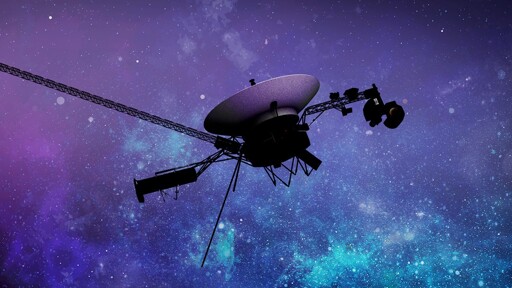
Engineers are confident that shutting down the LECP will give Voyager 1 about a year of breathing room. They are using the time to finalize a more ambitious energy-saving fix for both Voyagers they call “the Big Bang,” which is designed to further extend Voyager operations. The idea is to swap out a group of powered devices all at once — hence the nickname — turning some things off and replacing them with lower-power alternatives to keep the spacecraft warm enough to continue gathering science data.
What a badass little craft to have kept operating for so long. 🫡
Check out AMSAT-OSCAR 7 – Closer to home, but launched in 1974, and still waking up when there’s sun to operate. It’s the oldest “operational” satellite still up there. https://en.wikipedia.org/wiki/AMSAT-OSCAR_7
Fucking A good on ya for the heads up. I somehow haven’t heard of this one.
AMSAT = Amateur Satellite! Holy shit. Amateur, my ass.
RTGs are subject to the issue of half-life - this is a consequence of that type of power source. Though, let’s be honest: we do not have any other sort of power generation technology that would be viable for literal decades on an interstellar space probe. And we definitely didn’t have a better alternative when they were launched.
For roughly three milliseconds I thought to myself they shoulda used solar panels instead.
“Oh, wait…”
Well they could power a lamp that shines on the solar panels.
Use the heat from the lamp to boil some water and you’re in business.
Just use two of them!
NASA’s Voyager engineers are like the final evolution of your uncle that keeps his 1974 Chevy C/K running at 400,000 miles. It’s the same autism across an ocean of resources.
It is amazing they can detect and communicate to something with such a weak signal so far away.
So far away that it takes an entire day to get the signal to it. The earth to the sun is 8 minutes.
And somehow we can still talk to it. It’s amazing.
About 1/3 of a % of a lightyear that’s hardcore that we’ve gotten something out that far.
It also gives you an idea of how big space is. Lots and lots of nothing.
I was actually looking into this a little bit recently and it turns out the Voyager spacecraft launched with 23 watt radio transmitters but at the distance it takes a 72 meter dish to capture the signal and at its capture it is one attowatt. I don’t remember my system right offhand, but it’s something like a billionth of a billionth of a watt. It’s stupidly small.
Only 49 years!
Enshitification.
Doesn’t even run Outlook, let alone two. Pathetic.
At least they got that part right. It runs Pine.
Mutt was too much.
It’s quite a feat of engineering to have something run this long - and without having physical access to it.
This is so fuking cool
I am filled with pride that we collectively made something that will likely out live our sun, and we continue to find ingenious ways to keep it going and going
What a cool time to be alive
Here are Images Voyager Took.
I have no idea how to sort them by recency; I’m guessing it’s not sending such expensive data anymore, but what are the most recent (and furthest) images?
When is the next conjunction of planets that enabled the Voyager missions happening and are we preparing for it?
The Voyager mission launched in 1977. If I recall correctly, it takes roughly 80 years for the planets to realign for that purpose. If I didn’t misremember, we’re about halfway through waiting.
which would shut down components on its own to safeguard the probe, requiring recovery by the flight team — a lengthy process that carries its own risks.
Uhhh… how the fuck are you planning on recovering it?
would be great to have some solar that would power a beacon or something if it ever entered another star system.
Radiation and cold would have killed any electronics long before it would get to another system. And with the electronics dead, nothing would be able to tell the beacon to activate.
it would destroy them so when heated and energized they would not work?
Is there radiation between stars? I’m sure it’s cold tho.
Wait does solar power work with other suns? Or just our sun (Sol)? Or just yellow dwarf suns?
as @zalgotext@sh.itjust.works said. it should depend a bit on how its made. there have been things about making panels that would absorb frequencies we have at night. There are trade offs. I was under the impression that the reason plants are green is because they specialize on the red side which is more prevalent and then the blue because its the most energetic or something. Also I was under the impression most stars look basically white but the color thing is based on spectrums that predominate but like when you look at the sun it looks white and even a red star would look mostly whitish.

One would think we should just ship it some upgraded parts on a door dash rocket, since we presumably have far better technology now.
No? No? Oh well I guess the USA is not that great then,
The problem is that you’re not just sending parts out there. You have to:
- get the upgrade rocket going fast enough to actually catch up with something going very fast with a 20 year head start
- slow down once you get to it.
- make the upgrades while floating in space on a piece of hardware that was designed not to be upgraded and built on earth (hope you don’t need gravity for disassembly) that you control on a 30 minute delay.
At that point we could just launch a whole new satellite with better hardware, going faster, and covering a completely different area of space. Which is what we have done. But we can still make use of the system we have out there. It’s still the furthest out, so it’s still worth using for as long as we can
We haven’t sent anything away from the sun faster than Voyager 1. It’s still the fastest.
Isn’t a major challenge of trying to surpass Voyager 1 that it had extremely good conditions for slingshotting off a lot of planets?
Yes, although we have ion thrusters now, so theoretically we could use something like that to get something going very fast over a long time. A little acceleration constantly over a long time goes a long way.
That’s a fair point. And I hear the transmissions they send and receive are making even scientific appliances from the 90s onwards look like bitches. My math might be far off but isn’t a transmissions from the Voyager currently reaching us at a power about six orders of magnitude lower than a pin falling on the ground? And the dishes still catch them.
(“In space no one can hear you scream” my ass)
In space we can hear you scream, a long time later, and very very quietly.
This is just dumb