https://medium.com/@hrnews1/the-value-of-nvidia-now-exceeds-an-unprecedented-16-of-u-s-gdp-ede4b541b24c Sixteen percent of GDP. Think about that number.
The United States has tethered 16% of its entire economic output to the fortunes of a single company. Not an industry. Not a sector. One company. NVIDIA.
This isn’t diversification. It’s not even speculation. It’s national self-delusion dressed up as innovation.
America has done this before. We worshiped General Motors until it collapsed. We inflated the dot-com bubble until it burst. We built an entire financial system on subprime mortgages until 2008 taught us otherwise. We learned nothing…. NVIDIA’s Unchecked Dominance
NVIDIA makes graphics processing units. They’re very good at it. Their chips power AI models, crypto mining operations, and cloud datacenters. The company’s market capitalization has surged to over $5 trillion.
Wall Street cheers. Politicians brag about American technological superiority. NVIDIA’s CEO becomes a rockstar.
But here’s the truth: concentrated market dominance is not strength. It’s fragility masquerading as power.
NVIDIA controls between 80% and 95% of the market for AI chips used for training and deploying models. Their H100 and A100 processors are the gold standard for training large language models. Every major tech company — Microsoft, Google, Amazon, Meta — depends on their hardware.
This isn’t resilience. It’s a single point of failure with a stock ticker.
Revenue concentration tells the story. NVIDIA’s datacenter segment accounts for over 88% of total revenue. Remove AI hype from the equation and you’re looking at a company propped up by speculative frenzy, not diversified industrial strength. The Dangerous Over-Leverage of the U.S. Economy
Sixteen percent of GDP.
Let me say it differently: If NVIDIA stumbles, America doesn’t just lose a tech darling. It loses jobs, investments, pension funds, and the entire AI narrative Wall Street has been selling.
The ripple effects would be catastrophic. Tech slowdown. Financial contagion. Investor panic. The kind of systemic shock that makes 2008 look like a practice run.
And what’s America’s backup plan? There isn’t one.
We’ve bet the economy on corporate hubris rather than building diversified industrial capacity. We’ve confused market capitalization with national security. We’ve treated stock prices as a measure of geopolitical strength. It’s reckless. It’s stupid. And it’s quintessentially American.
No other advanced economy would tolerate this level of concentration. Germany doesn’t pin 16% of its GDP on Siemens. Japan doesn’t hinge its future on Toyota. Even China, for all its centralized planning, spreads risk across multiple state champions.
But America? We put all our chips on one chipmaker and call it genius. Supply Chain Fragility and Geopolitical Shortsightedness
NVIDIA doesn’t manufacture its own chips. Taiwan Semiconductor Manufacturing Company does. TSMC produces an estimated 90% of the world’s super-advanced semiconductor chips, and more than 90% of the most advanced chips globally are manufactured in Taiwan.
Taiwan. An island 100 miles from mainland China. A territory Beijing considers its own. The most geopolitically volatile piece of real estate on the planet.
This is where America has decided to anchor its technological future.
TSMC’s most advanced facilities are in Hsinchu and Tainan. If China moves on Taiwan — through blockade, invasion, or economic coercion — those fabs go offline. NVIDIA’s supply chain evaporates. America’s AI ambitions collapse overnight.
And China knows this.
Beijing is pouring resources into semiconductor self-sufficiency. SMIC, Huawei, and other Chinese firms are reverse-engineering NVIDIA’s architecture, with Huawei’s Kirin 9000S processor — produced in SMIC factories — providing tangible proof that China can produce advanced chips locally despite embargoes.
Analysts project China will achieve a true 5nm-based chip by 2025 or 2026. SMIC is approximately a handful of years behind TSMC in process technology.
Five years. That’s the gap between American dominance and Chinese parity.
Export controls won’t save us. Sanctions won’t stop reverse engineering. The U.S. can restrict NVIDIA from selling advanced chips to China, but it can’t prevent Chinese engineers from studying, replicating, and eventually surpassing American designs.
History is littered with technological monopolies that thought they were untouchable. Britain dominated textiles until America stole the designs. America led in consumer electronics until Japan refined the process. Japan ruled semiconductors until Korea and Taiwan built better fabs.
Overconfidence breeds catastrophe. Always has. Always will. Market Myopia and Investor Complacency
NVIDIA’s price-to-earnings ratio has fluctuated wildly, hitting levels that would make even dot-com speculators blush. At its peak, the company traded at over 70 times earnings.
This isn’t valuation. It’s religion.
Investors assume AI demand is infinite. They believe NVIDIA’s dominance is permanent. They think American tech exceptionalism is a law of nature rather than a temporary advantage.
They’re wrong.
China’s chip industry is advancing faster than Western analysts predicted. Reports indicate Chinese companies are achieving 5nm chip production using deep ultraviolet lithography without access to extreme ultraviolet equipment.
The gap is closing. And when it closes, NVIDIA’s moat disappears.
American investors are complacent. They see NVIDIA’s stock price and assume supremacy. They ignore competitive threats until it’s too late. They confuse market hype with sustainable advantage.
It’s the same myopia that convinced investors pets.com was worth billions. The same delusion that made Enron look invincible. The same arrogance that inflated every bubble in American financial history.
Where is America’s industrial policy? Where’s the strategic planning? Where’s the diversification?
Nowhere.
Washington reacts to crises. It doesn’t prevent them. The CHIPS Act allocated $52 billion for semiconductor manufacturing — a pittance compared to the scale of the problem. It’s a band-aid on a hemorrhage.
Meanwhile, China created the China Integrated Circuit Investment Industry Fund to channel an estimated $150 billion in state funding to support domestic industry. South Korea and Taiwan have invested hundreds of billions more.
America is being outspent, outplanned, and outmaneuvered. And yet, policymakers still assume tech dominance is our birthright.
Anti-trust enforcement is toothless. Strategic planning is non-existent. Industrial diversification is treated as anti-market heresy.
The result? America has a “too-big-to-fail” tech company that nobody wants to regulate, nobody wants to challenge, and everybody assumes will last forever.
We’ve been here before. AT&T. IBM. Microsoft. All seemed invincible until they weren’t.
The difference now? NVIDIA isn’t just a monopoly. It’s a systemic risk. And nobody in Washington seems to care.
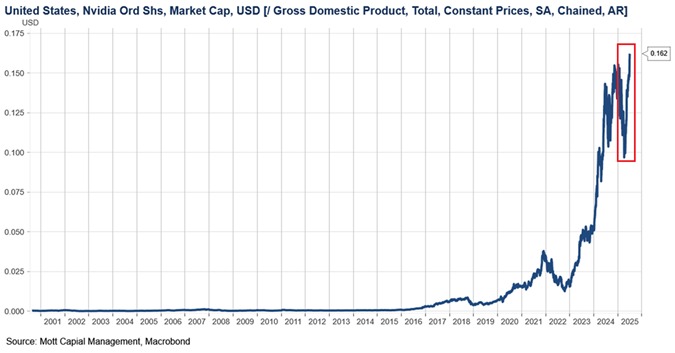
Sixteen percent of GDP…The United States has tethered 16% of its entire economic output to the fortunes of a single company
That’s not really how that works. Those two numbers aren’t comparable to each other. Nvidia’s market capitalization, what investors are willing to pay for ownership of the company, is equal to sixteen percent of US GDP, the total annual economic activity in the US.
They’re both dollar values, but it’s like comparing the value of my car to my annual income.
You could say that the value of a company is somewhat-linked to the expected value of its future annual profit, which is loosely linked to its future annual revenue, which is at least more connected to GDP, but that’s not going to be anything like a 1:1 ratio, either.
So, the US GDP is about $30T. Walmart revenue is about $700B, or 2.3% of GDP. Amazon, 2.1%. United Healthcare, 1.3%. Roughly one out of every 20 dollars spent in the US goes to Walmart or Amazon. That’s kind of terrifying.
The original source was much more sensible.
The comparison makes sense for evaluating whether you’re over-invested in something. Like, if Nvidia suddenly poofed out of existence, would it seriously be worth 16% of everything the whole country makes in a year to get it back?
Owning a car that’s worth 16% of your yearly income sounds reasonable, no matter what your actual income is. A Pokemon card collection that’s 16% of your income is probably too risky, no matter what your actual income is.
Also, GDP is a decent scale to use for charting investment in a productivity tool, because if GDP ramped up at the same time as investment then it looks less like a bubble, even if they both ramp up quickly.
But that’s not what we see. We see a sudden and volatile shift, nothing like the normal pattern before the hype.
They’re both dollar values, but it’s like comparing the value of my car to my annual income.
The thing that every bank does in order to decide if they should give you more money?
And if the us government were lending someone money to buy Nvidia, that may be relevant.
Get that first week of Macroecon 101 shit out of here before I go into outrage withdrawal.
Thank you. I mean what??? The phrasing is idiotic. This company has a large market cap, therefore the US has “tethered its economic output” to it? What’s that even supposed to mean?
I want to make a clarification here before we all get too far ahead with “16% of GDP”. There are many things wrong with the way giant tech companies dominate their respective fields. However the value of a company does not equal its’ share of the GDP. GDP is the OUTPUT of a country in 1 year. It does not equal the value of all the private enterprises combined which is what this comparison is trying to do. What we want to compare then, is to take NVIDIA’s output in ONE YEAR and see how much of the economy it dominates. US GDP is ~ 30 trillion in 2025. Nvidia’s output or revenue for current fiscal year is ~ $200 billion. That’s 0.6% of the GDP. That’s far cry from 16%, by about 27 times less.
What we should be concerned are the size of the market cap of these giant tech companies dominating the total value of the stock market, as well as the monopolistic margins these companies enjoy. All of these contribute to the imbalances in the world we see today - in the economies, in the society and social structure, and in politics. Communism once rose two centuries ago in protest against the concentration of power in the hands of a few. A solution is needed to remedy the imbalances of today.
Thank you, I came here to complain about the false equivalence between entire company value and sum of all trades for a country in a year
Yes, thank you. A lot of people live in a house that’s worth more than they make in a year. We can write a breathless sentence that makes this sound shocking if we like.
“Think about that number. You have tethered 450% of your economic output to the fortunes of one structure!”
There is no solution i think. The entire economic system is about creating those imbalances. In other words, monopolies are the end goal of capitalism, for the companies.
I mean, unless you want to constrain unlimited capitalism but America is not about that. Europe is doing that.
The rich people in America now are practically running the country and its decisions. I dont think there is a solution when people have become that powerful and rich.
but that contradicts the great justification for capitalism: efficient markets. Monopolies are the exact opposite of efficient markets.
Are they? I see monopolies everywhere and they seem super efficient for bringing in billions of dollars to the owners, which in turn becomes incredibly powerful and influencial people. Their decisions affect the entire planet now.
What is the definition of an efficient market?
If you trust Adam Smith, an efficient market would quickly make new goods and services available for the lowest possible price. People are supposed to be incentivised to sell things, and competition is supposed to stop an excessive amount of money being diverted to profits instead of reinvestment and price cuts. There are supposed to be systems in place that ensure that there are always opportunities for competition, but the wealthiest have the most power to erode those mechanisms and the most interest in eroding them, and neoliberals think an Ayn Rand novel is the definitive text on how capitalism works rather than Adam Smith’s work, so even if you land in the capitalism makes everyone better off mode, it doesn’t last for long before it falls back into fuedalism with extra steps mode.
Yeah. I remember reading about Adam Smith in school, and it made perfect sense then. But after seeing the actual world, it seems it just falls apart.
Nvidia doesn’t make GPUs. TSMC does.
Nvida just sends them their design specs.
Apple, Google, Nvidia, etc. - all TSMC in Taiwan. A country that China would love to occupy given a good motivator.
Evaluation, not value.
Evaluation is the act of putting a value on something
This pedantry is not helpful and does nothing to defray the problem
“Putting a value on something” vs. “Something having a discernable value” is the point.
Do you really think that they can pay 5 trillion dollars, or even the 20% of this, to the the shareholders ?
I’m not going to spend time on how dumb it is to compare a speculative total valuation to the real economic output of a single year.
If we zoom out, it’s not that surprising that emerging tech is going to require greater and greater computing power. We thought that our desire for our laptops to be faster was driving this, Moore’s Law, whatever. But now there’s a new technology that seems to raise the requirements by an order of magnitude. In the short term, this is fantastic news for the makers of computer chips. We’re living in the late Information Age. Is it all that surprising that there would be moments like this where our ability to consume computing power outstrips our ability to produce it? So Nvidia has a high valuation. BFD. Investors are confident in its future. That doesn’t make it 16% of the US economy.
I have similar concerns, comparing gdp to valuation seems nonsensical. But at the same time the valuation is still ludicrous. Nvidia designs chips, TSMC makes them, datacenters buy them, datacenters sell the compute to AI vendors like openai who sell services to customers for a price that doesn’t cover even a fraction their costs, let alone being profitable.
In my book, either two things will happen. Before the money runs out, the AI companies will hit their stated goal of AGI, but without doing any of the safety work, and then everybody dies. The money running out and GFC 2.0 is the “good” ending. If I was even remotely confident in my ability to guess the timing of how it would all play out I’d be shorting up to my eyeballs.
Don’t feel bad. I don’t think shorting can do any good. Betting we won’t need powerful chips in the future seems like a bad bet. The main scenario where we won’t is if we’re all dead, in which case all stock market bets are worthless anyway.
I can say that nvidia is way overvalued and that it’s share price is going to go down without saying that we won’t need powerful chips.
Don’t tell me. Go short the stock and make a million.
As I already said, it’s impossible to time it and you’d be an idiot to try. There could be three more years of bubble first in which case shorting on margin would be ruinous. “Markets can remain irrational a lot longer than you and I can remain solvent” yada yada.
This is the exact type of thing you see near the peak of a bubble.
I just read scion capital, Michael Burry, just put in a lot of short positions in Nvidia and Palantir
totally not a bubble though.
Totally not a bubble. At all.
deleted by creator
We learned nothing? lol my dear friends.
THEY learned how to do it better and we the people learned to bend over and take it.
pop goes the bubble?
I just want cheaper graphics cards so I can play my nintendo games.
Then you want real and enforced competition.
There is no way a graphic card company could account for that high of a percentage. This is definitely not going to end well.
Nice article. Thomas Goldfreburg comes across as an experienced gold investor who also works as a consultant in that area.