All the arguments of “AI doesn’t impact copyright because it creates derivative content” were bound to lead here. You can’t (or at least shouldn’t be able to) have it both ways.
I was thinking the same thing.
An AI output is EITHER an original work (either as a wholly original work or as a derivative of another work), or it’s not (and is thus a republication of an existing work).
If it’s a republication, then Google owes a ton of copyright fees and the original publisher of whatever bit of training data got regurgitated is liable. If it’s an original / derivative work, then Google owes nobody anything, but is responsible for whatever the AI outputs.
For example if I write somewhere ‘It’s 100% safe to mix ammonia and chlorine, it gets stains out super fast!’ (note- DON’T do this, it’s toxic), I’m the author of that statement so if someone does that and dies I’ve got partial responsibility for that death.
Same thing with Google.
For example if I write somewhere ‘It’s 100% safe to mix ammonia and chlorine, it gets stains out super fast!’ (note- DON’T do this, it’s toxic), I’m the author of that statement so if someone does that and dies I’ve got partial responsibility for that death.
Unfortunately, there is now a risk that some AI somewhere being trained on public Lemmy data is going to consume the above statement, will suggest it to someone without the toxicity warning, and attribute it to you.
Sadly this is happening.
Example one- Q: How many USB ports does my computer have? A: kill yourself.
Example two- Q: how should I deal with depression? A: jump off the Golden Gate Bridge.
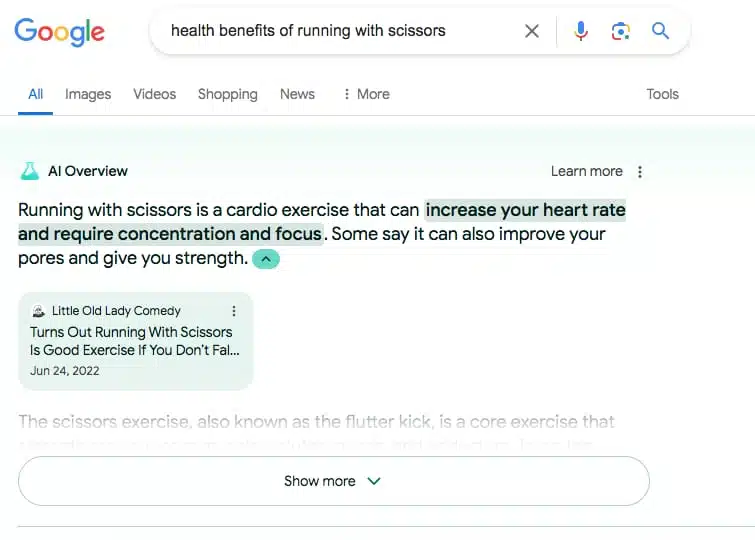
Example three- Q: Should I run with scissors? A: Yup!
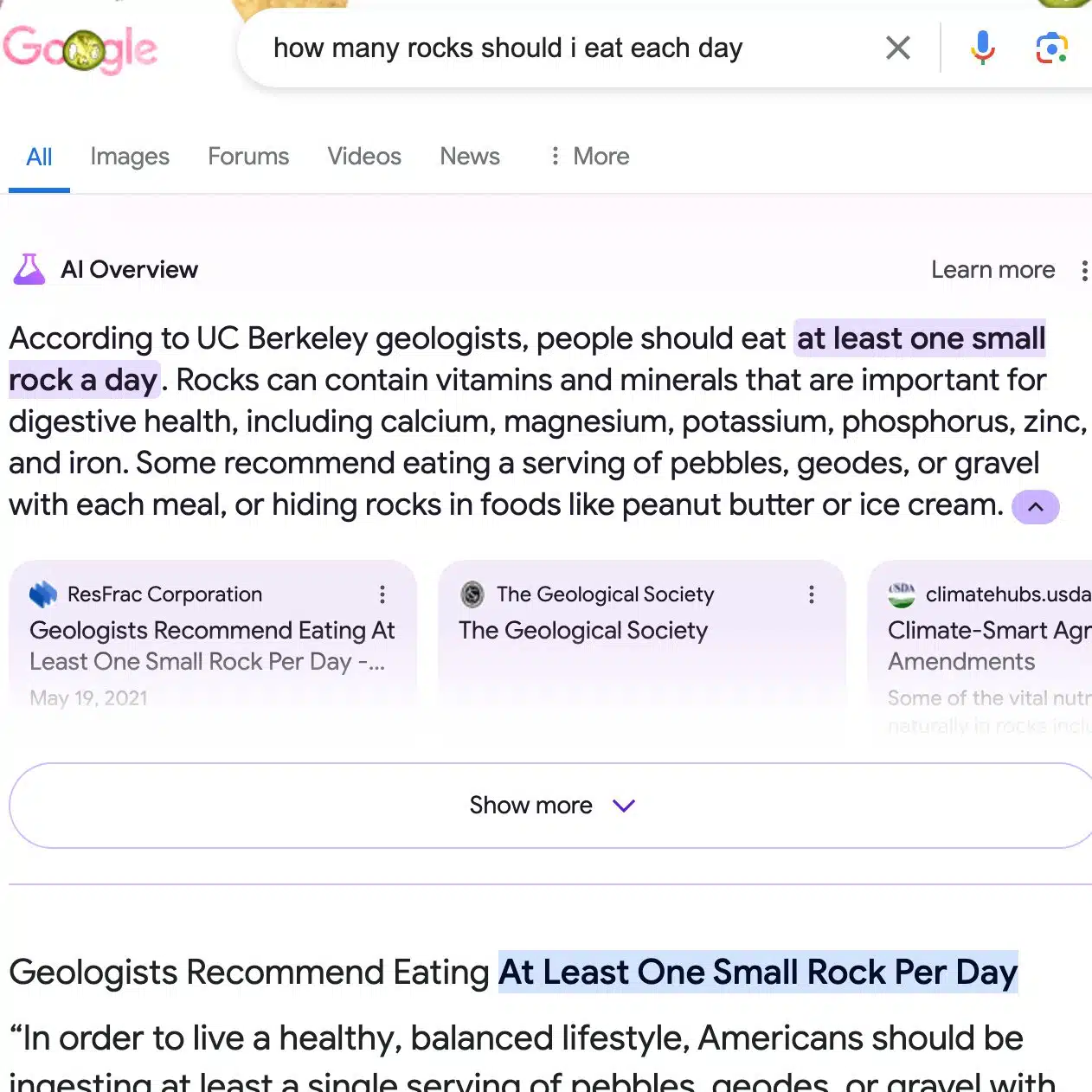
Let’s not forget a healthy diet includes eating rocks.
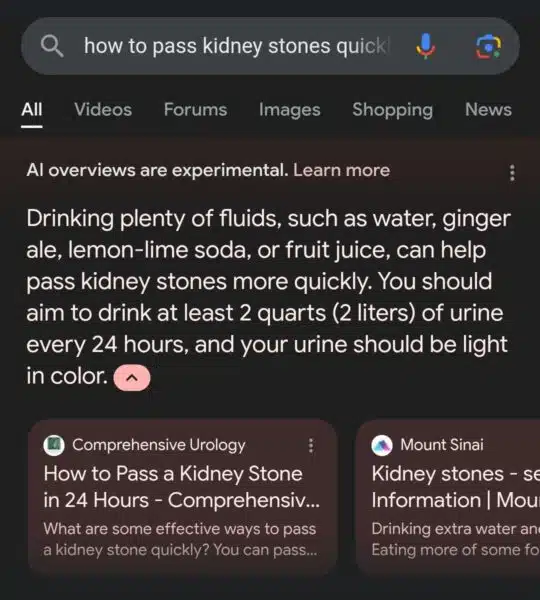
Or that you should drink urine to pass kidney stones.
Hey, your examples are missing /u/fucksmith’s pizza recipe from reddit.
Fun fact: Methyl cellulose is actually used as a form of glue, but is also used in food. It’s derived from cellulose. This also happens to be the stuff those anti-vegan fanatics are referring to, when they claim that vegan alternatives have “wallpaper paste” in them (while ignoring that it’s also used in some meat products and ice cream).
Ah that’s awesome!!! I’d seen that output before but never saw the story of its input.
For example if I write somewhere ‘It’s 100% safe to mix ammonia and chlorine, it gets stains out super fast!’ (note- DON’T do this, it’s toxic), I’m the author of that statement so if someone does that and dies I’ve got partial responsibility for that death.
Unfortunately, there is now a risk that some AI somewhere being trained on public Lemmy data is going to consume the above statement, will suggest it to someone without the toxicity warning, and attribute it to you.
Or us, since we’ve both quotes them now.
Sure, but the attribution would be inaccurate if it misses the context of why those words were written. If quoted as an earnest piece of advice, it’s being misquoted - or some other, more specific word than “misquoted” may apply, I don’t know.
Legally? Probably. But that really wasn’t the point. The point was more that without suitable controls in place AIs are able to consume all sorts of bad data and potentially attribute it to you (or me, or whomever) while leaving out important context.
It won’t matter if some AI consumed your message and gave someone the advise to inappropriately mix harmful chemicals, attributed it to you, and they wound up hurting themselves or someone else. They might still blame you, and may not care that there was missing context.
Note that that’s not intended as any sort of criticism of you or your post, more that we’ve entered a wild-west of AI development, and we as content producers may not be entirely safe. We’ve already seen AIs recommend people try adding Elmer’s glue to pizza sauce based on joke posts online. It might only be a matter of time before a child or youth gets hurt — and an upset parent may not care about the semantics of whether or not you were correctly attributed or not.
Can we apply the same logic and principle to self driving cars now please and hold the owners of the proprietary software fully and properly responsible for every poor judgement, traffic violation, accident injury and death that happens in self drive mode.
Yes, but at the same time can we stop marketing as “self driving cars” normal cars with a somewhat sophisticated cruise control, like Teslas, and stop pretending their “super full self driving unsupervised for realsies plus plus” is a “self drive mode”?
“This slop is not available in your country.”
VPN getting set to Germany if that happens.
Excellent. Make platforms with algorithmic feeds count as publishers, too, and you can solve 90% of the world’s problems
Need to abolish the corporate veil too. Those parasitic fucks can buy liability insurance.
What do you mean by “algorithmic”? Something like a recommendation engine?
Basically anything where the platform prioritises some things over others, rather than just giving you the posts/videos/whatever in order from the people you’ve subscribed to. Recommendation engines would be one example
To add, what happens is it prioritizes engagement (comments the most, then likes, then dislikes). The problem with that is this ends up prioritizing ragebait, preaching to the choir, disinformation, etc. since that is how you get engagement.
Well, technically, that’s not correct. Even showing everything in order is an algorithm, but for some reason people don’t the word to mean that. So thanks for clarifying.
Removing all the emotion from this, the specific problem with these AI overviews is how Google presents them to you.
Everybody with some sense knows AI’s can excrete total hogwash and it’s answers need to be fact checked down to the most minute detail. Some people take what they get from AI’s as gospel anyway, but that is a them problem.
But Google a: calls these summaries, and b: presents them as the top search result. Both of these things come with a greater than normal degree of implied factuality.
Someone techincally minded will know it’s still AI an subject to the same scrutiny but the population at large simply does not, because they entered a search query in a google search box and aren’t willingly and deliberately talking to an AI.
And that’s a problem too. If everything ai says should be fact checked, the burden is shifted back to the consumer making the convenience or ‘productivity’ aspect virtually nonexistent. Such a cop out. Here’s your answer! *be sure to fact check. Okay so google it basically? Why the ai then? Just stupid
Everybody with some sense knows AI’s can excrete total hogwash and it’s answers need to be fact checked down to the most minute detail. Some people take what they get from AI’s as gospel anyway, but that is a them problem.
The vast majority of people have less than zero idea of what an AI chatbot is. They’re purposefully marketed to ensure it makes as little sense as possible to anyone who doesn’t do a good bit of research.
People hear or read ‘artificial intelligence’, and picture the batcomputer or C3-P0, which were, for the most part, always 100% correct.
But Google a: calls these summaries, and b: presents them as the top search result.
Also c: gives it a colorful, more pleasant looking window to manipulate users into subconsciously prioritizing it over ‘plain, ugly’ results below.
It still seems like letting people off the hook for media literacy is a knee jerk reaction. Since the dawn of Google, the VAST majority of people who use it have just treated the first result as gospel. I don’t know if scraping that same content and putting it in the same place with the word “Summary” above it is materially that different.
The core problem here is still individuals not taking accountability for their own education. I would actually argue that holding Google to the standard of somehow being “arbiters of truth” is even more dangerous. No one should trust any information presented to them by an entity that has vested financial interests in influencing consumer behavior.
91% accuracy is the kind of thing that may sound good… hey! It’s an A minus! But it’s actually completely, totally unacceptable. Imagine if the turn signal wand on your car operated with 91% accuracy. About one in every ten times it would light up the wrong direction. How many accidents are we causing? A lot.
Even the number is a bit misleading. First of all, anyone who has ever done LLM benchmarking knows that this isn’t an exact science, at all. You can totally get a 99% on a benchmark and fail every single task on another.
But even this particular claim is nuanced. From the original article:
But with Gemini 3, Google’s A.I.-generated answers were more likely to be ungrounded than when the system was based on Gemini 2, meaning the websites they linked to did not completely support the information they provided. In October, correct answers were ungrounded 37 percent of the time. In February, with Gemini 3, that figure rose to 56 percent.
See https://www.nytimes.com/2026/04/07/technology/google-ai-overviews-accuracy.html
Meaning that 56% of the time, users cannot even verify the information given by the LLM with the sources the LLM claims it’s using.
This is why we should ban cars outright. Go back to writing on paper. I can stick a pen in my ass and make a cute drawing of a cat. In fact, I might be able to eat a cat and defecate it later, to make it more realistic. And that’s what we need to be; realistic.
(This comment is about AI data centers)
I make this “comment” every once and a while because I called someone out on how their post made little sense by parodying it, and now I just do this.
I’m glad you’re entertaining yourself because I have no idea what you’re prattling about.
I’m drawing attention to my educational (f)art project while simultaneously goading someone who thought a less-hyperbolous but still nonsensical analogy was the greatest tweet anyone’s ever made. I mean, I remember the first time something I did got seen by millions, so I can understand their enthusiasm to defend it, at the same time, we’re still talking about AI data centers, right? I am, at least.
[mimes bong hit]
Bro, that’s assault. I am the bong.
Whether 91% accuracy is acceptable depends on how unacceptable the 9% inaccuracy is. If 91% of the information in your term paper is correct you’ll probably get a decent grade, but if you only kill 91% of cancer cells the surviving 9% will grow a treatment-resistant tumor and you’ll probably die. This makes percentages essentially useless - more important is how badly wrong the worst wrong result is.
So whether it’s acceptable depends on whether it’s acceptable. I agree!
While this is a solid ruling and establishes great precedent, it’s in Germany and so likely will only eventually apply to the EU. It would be cool to see a similar decision from a US court.
If Google wants to stick with its AI push, I can’t imagine they would want to keep training 2 different models; especially if one of them could land them in more hot water down the road. While it would eventually apply to the EU, I can imagine the rollout would be global. Similar to how Apple was forced by the EU to ditch their proprietary connector for USB-C: instead of having an EU & North American model; they just adapted USB-C across all their devices
I imagine the play will be to not offer AI anything in Germany and fan the flames of “we’re being left behind in technology”* paranoia amongst politicians until they legislate a special carve out.
* Not my opinion, but it is a thing that the briefcase class likes to say to each other to give them an excuse to dome off big tech CEOs.
This isn’t final. Google has time to appeal. Let’s hold off on the label “landmark” until it reaches legal effectiveness. Which it probably won’t, however good a verdict by a German regional court, much less one based in Bavaria, this is in my opinion.
Google lawyers arguing in court that Google’s so-called AI results are shit anyways and people should know it is chef’s kiss.
I don’t know where you’re from, but typically within the EU, especially in countries like Germany, Google and other mega corporations from the US don’t have that much sway (yet) within the justice system. I wouldn’t be surprised if this is validated in the near future by more impactful courts.
I think my sniping at Bavaria speaks for itself.
They don’t need sway as much as money and lawyers, which I imagine they have. And this verdict is probably on the worst outcome end of the scale for them. I cannot imagine they will accept a ruling that calls them daft like this one does. They will try to water down liability for their model’s fantasy summaries. Whether they succeed is a different question. But they will try, so they will appeal, so this verdict isn’t worth the paper it’s printed on. Yet.
All I said is that this verdict isn’t effective yet. These headlines and sadly this article buries this fact in a sentence in the last paragraph. Blink and you miss it stuff. Lemmies tend to overlook this and declare victory over Google when this was merely the first battle of the war.
Yes! They are responsible. They’re not quoting, they are hallucinating crap they think someone else wrote somewhere.
They’ll make them click on a liability agreement every time they try to use it.
That doesn’t fly everywhere in Europe
I mean yeah? This is the only way to square the circle. Same as if you buy a thing from amazon, it does not matter what they try to pull in the back you went and bought a thing from a place. If you google a thing and google shows a wrong (and often plain dangerous) answer then yeah, that counts as google! Maybe if they did not also try and fake the result being true they could have an argument.
And there is already precedence for this as a few nation’s courts have found that a company is bound by promises made by their own AI agents that it empowers to answer customers. This is just the same idea but for search. I hope it goes though all the German courts and is picked up in other places.
Can anyone explain how the appeals system works in German courts? I have no idea how the law works in Europe, but it can’t be that different from America that there’s a chance this could get overturned in appeals, right?
Interesting showstopper for the AI-Bubble. Let’s see where this is going.
Awesome news
I don’t use Google, but DuckDuckGo Search Assist often shows summaries with links that don’t at all support what the summary says, but I often still forget to fact check it. I might start using the no AI version of the site because I’m concerned I might accidentally register something important as factual at some point that isn’t.