

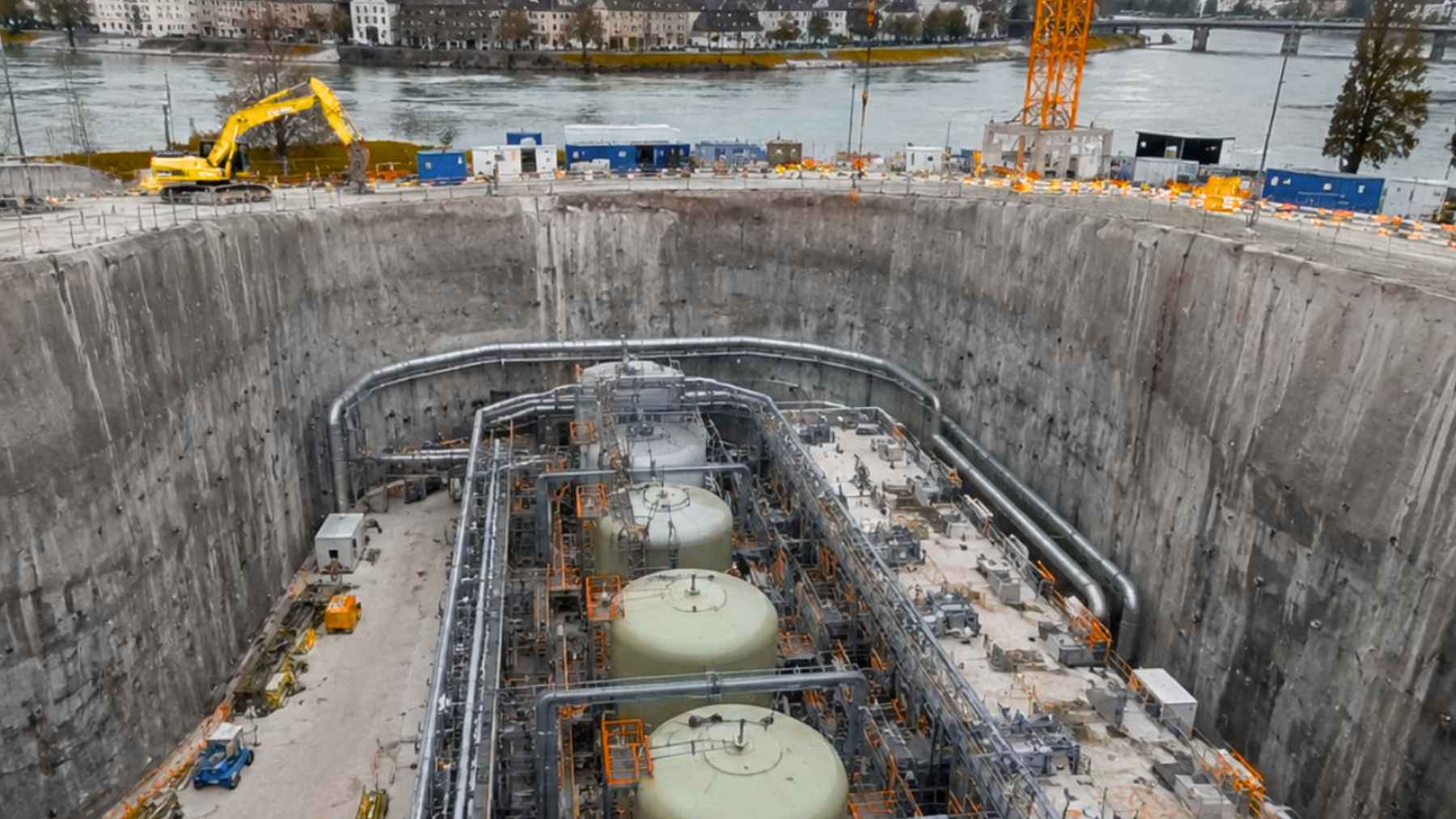

great scott
Fuck these incompetent headline writers who cant use units correctly. At this point they are doing this shit on purpose to ragebait people into reading the article. And they dont even explain what that headline is supposed to mean in the article. Does the output power ramp up that fast or do they mean that it can actually just output a lot of energy really fast?
I am also fascinated by the measurement “two soccer fields.” Americans largely play soccer on American football fields, so any American would just say “two football fields.” But everyone else hates calling it “soccer” and prefer to use metric rather than comparisons? This just seems like they chose all their measurements to be maximally irritating.
Yeah, nobody play soccer in Switzerland, they play football, how would they know how big is soccer field?
Actually, the headline isn’t wrong, you just read it wrong.
The article specifies:
- 2.1 GWh total storage capacity
- 1.2 GW peak output
- can ramp up to that peak output within milliseconds
Every power source has a ramp up time. Ramping up e.g. a nuclear reactor can take hours, so if demand fluctuates it takes long for it to spin up.
This one here can ramp up almost instantly to cover for fluctuations in the network, especially those caused by the unpredictable nature of renewable power generators.
Goddammit, they are 0.01 Gigawatt short of time travel. 😋
It says “over 1.2” which means you know what some engineer gave the spec as.
1.21 Jiggowatts?! Is there a GIF?
No, only a GIF.
Great Scott!
What the hell is a jiggawatt?!
The article doesn’t explain the battery, making it a bullshit site if you ask me, here is what they are talking about:
https://en.wikipedia.org/wiki/Vanadium_redox_battery
'The vanadium redox battery (VRB), also known as the vanadium flow battery (VFB) or vanadium redox flow battery (VRFB), is a type of rechargeable flow battery which employs vanadium ions as charge carriers.[5] The battery uses vanadium’s ability to exist in a solution in four different oxidation states to make a battery with a single electroactive element instead of two.[6]
For several reasons, including their relative bulkiness, vanadium batteries are typically used for grid energy storage, i.e., attached to power plants/electrical grids.[7] ’
I wanted to research it myself since I didn’t know how Redbox flow batteries operate. It is two giant tanks of liquid energy. When there’s extra electricity from wind or solar, pumps move special vanadium-based liquids through a stack of cells, storing that energy as a chemical change. When electricity is needed later, the process runs in reverse and the liquids generate power for the grid. Unlike lithium batteries, the energy is stored in the liquid tanks, so making the battery bigger is mostly a matter of building larger tanks. The Swiss project will store about 2.1 GWh of energy—enough to help balance renewable power on a massive scale—and was chosen partly because redox-flow batteries are non-flammable, long-lasting, and can be cycled tens of thousands of times with little degradation
I read some years back about I think the first big heavy industrial vanadium battery being built for some washington state company if I recall.
The headline looks wrong, but it actually isn’t.
The article specifies:
- Total capacity: 2.1GWh
- Peak output: 1.2GW
- Ramp up time: a few milliseconds
That’s what the “within milliseconds” in the title refers to.
Every power generator has a ramp up time. Think the time it takes to start the engine in a diesel generator, until it spins up and is able to output peak power.
Nuclear reactors can hare ramp-up times of hours, in some conditions even days.
This thing here can go from zero to peak output within almost no time, which makes it perfect to balance the sometimes erratic and unpredictable generation fluctuations of renewable energy production.
For comparison, coal or gas power generators usually have large flywheels that, once spinning, react almost instantly to power fluctuations in the network by converting their motion to electricity or the other way round. If these coal or gas generators aren’t running, they can’t be used to balance the fluctuations in the network, so battery solutions like the one in OP are required to actively manage the network stability.
Thanks, I edited the headline to make it clearer, but this community is overrun with confidently incorrect folks.
…this community - oh, you mean social media! Yes, quite true.
Perfect power source for a Death Star! The planet goes from zero to smithereens in milliseconds!
We don’t know soccer fields around these parts…
Anything but the Imperial System huh?

able to output 1.2 GW within milliseconds
By exploding?
Yeah, that’s a bit too much a bit too fast, isn’t it?
1.2GWh within milliseconds would be exploding.
Read the headline again, it only talks about GW not GWh. That means it can output 1.2GWh per hour, but it can ramp up to 1.2GW within milliseconds. And it likely can only keep that output for a very short time, which is exactly what you need to balance the fluctuations of renewable energy production.
this will be by far the largest vanadium flow battery in the world, especially outside china


Flow batteries eat lithium batteries on paper and they are so scalable too!
Wow its much bigger than Chinas.
The Swiss are on the frontline of climate change seeing that it is destroying their mountains which in turn are destroying their villages. Sad times.
What is a size of a soccer field
7140m²
Don’t stick your thing in it!!
Remember Wally? Ooof. I mean, kind of a jerk and all but. What a way to go.
$1 per WH or almost that is pretty terrible. You can get battery systems for 1/4 of that $/WH at Home Depot.
Yeah, I agree that decentralization of the grid and self-consumption is better than these mass baseload solutions…but they will only get cheaper.