
They’re a great idea if you happen to own a company making AI, a company making rockets, and a company controlling public opinion.
deleted by creator
And an excellent way to scam a little. And fleece the flock
My question is always how the hell are you going to cool them. Do you know hard it is to move heat in a vacuum?
The problems; plural; is that the person who popularized the idea of data centers in space has little to zero understanding of any of the space sciences and yet owns and directs one of the world’s largest, and privately owned, aerospace companies with massive government contracts that splits its time with their own AI work.
We already have data centers in space.
A radiator. Next question?
What’s going to be performing convection to dissipate heat from the radiator in a manner to support the heat generated by an AI data center?
Obnoxious as he seems to be, he’s actually right, there will be no convection, but they’d radiate heat in a vacuum, by IR IIRC.
To do that they’d have to be filled with something other than something water based to be able to do that over a large area which would require constant maintenance to do so. It’s not easily feasible and I doubt people who want to do this or defend it realize that. I have to look it up but it takes Anhydrous Ammonia to perform that in the ISS. Like this is a bad idea and it fries my brain people trying to defend this.
Yeah as I have already said, it’s kind of impressive how bad the idea is, I mean how can it be worse…
What part of radiator don’t you understand?
Tell me you don’t know how radiators actually work without telling me. They dissipate heat via convection through the air surrounding them or gasses in general. What does space lack a significant amount of?
Radiators dissipate heat through…wait for it…
Radiation.deleted by creator
Right… and a carpet is a pet you keep in your car, got it.
Do you know how BIG they would have to be to dissipate a data center worth of heat to keep it as cool as on earth?
Do you?
Do you know how much heat they would need to retain?
With radiators just like with every existing satellite system.
https://youtu.be/DCto6UkBJoI&t=12m57s
Very large scale datacenters would likely have some nasty fluid handling problems to solve.
I’ll just note that I am not a fan of putting internet infrastructure in space. I think polluting the upper atmosphere with a bunch of metals every time a satellite deorbits will certainly have negative consequences. So IMO space should be limited to things we can’t do with earthbound infrastructure.
Removed by mod
The area of radiator needed directly corresponds to the amount of power harvested by the solar panels. It doesn’t matter what the load is. So a compute frame with the same amount of solar panels as the space station would need approximately the same radiatot area as the ISS, unless you are bringing nuclear power into the mix.
I agree that space based datacenters are a bad idea, but the thermals really are not the gotcha people are making them out to be.
They’re called fins, not panels.
You seem rather dull.
They’re called fins. Not panels.
Removed by mod
Yeah the amount of heat a data center vs a satellite your going to super heat the space in that orbit over time. It they are geostationary then its even harder as the the data center doesn’t move away from the heat.
Geostationary satellites are not standing still. They’re orbiting the Earth at the same rate that it rotates “beneath” them.
Super heat what in that space? The point is there’s nothing to transfer heat to. All you can do is radiate infra-red light.
Radiators in space work by radiating electromagnetic energy(light). Heat can only accumulate in matter, not in space, so that is definitely not one of the things we need to worry about.
geostationary then its even harder as the the data center doesn’t move away from the heat.
Geostationary would leave the satellite in shadow anytime it was night time over the part of the earth since a geostationary orbit is stationary in the sky over a given point at the equator.
That doesn’t solve any of the cooling problems just saying that you do get some shadow at geostationary orbits.
There are other orbits that get less shadow though.
It’ll be in shadow at midnight, yes, but not necessarily at any other time. Geostationary orbit is at about 7x the radius of the earth.
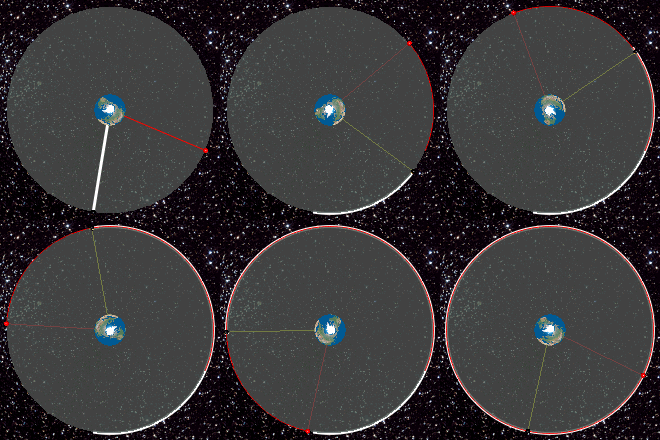
As such, the period when in will actually be in shadow is only a short period directly behind the planet.
How would you power them?
The surface area of solar panels exceeds the surface area needed for radiators to cool everything.
In space I would imagine you’d find the perfect sandwich ratio. One bun solar, one bun radiators, the meat being the racks.
I don’t think the point is to really build datacenters in space. The point is to convince investors that it can be done in a profitable manner so some people can create a fake businesses out of it and siphon money off the system. Much like the same as trying to convince investors that LLM + more money = AGI
I also wonder if this is an entire red herring. There are increasing reasons for more compute in space, such as to pre-filter sensor data.
Is it to naive/optimistic to think no one is actually looking for a space datacenter to compute terrestrial loads, but they recognize the need for processing space loads?
See now you all are thinking.
The rich wouldn’t tell us this shit if it wasn’t going to be used as some spin/distraction whatever it is.
It’s a legal thing. No (real) jurisdiction. In space nobody will shut down Grok generating kiddo porn. It’s basically the precursor for Epstein Island 2.0.
Don’t data-centers require massive cooling?
Yes, and it’s easier to cool things on earth. In space, there’s no air to help you cool thinks off, you can only reject heat through radiation. Most spacecraft are carefully designed to reflect heat/light on surfaces facing the sun and radiate heat into empty space from surfaces that are shaded.
In space there’s no epa
What if you build it on an asteroid or moon or planet. Uranus is ~-225⁰C, right?
Yes, but the two-and-a-half hour lag each way would be a killer.
My understanding is that these “datacenters” would be used exclusively for model training, where latency doesn’t matter.
It is still an outrageously stupid idea for a zillion other engineering reasons, though.
There’s also the issue that around once a year the two planets will be on opposite sides of the sun. Not only would you have a lag of close to 3 hours, but communication would be completely impossible for a month or so at a time.
It would need to have an atmosphere, so asteroids and most (all? Idk not an astronomer) moons are out.
Mars might be feasible at some point in the far future, but there’s still the lag problem of 3-20 minutes depending on time of year, so not very useful for anything user facing.
most moons
Pretty much every moon but Titan. Titan, however, would be excellent for heat dissipation. Long before generative AI was even a thing, scientists have speculated that Titan would be the perfect place for datacenters because low-temperature computation is so much more efficient.
Of course, building a datacenter on Titan would be a several-hundred-trillion dollar endeavor, so… good luck bootstrapping your way into that industry.
I heard they are investing into moonshot projects.
There’s another problem that nobody mentions. Putting thousands of additional satellites into space would seriously increase the risk of Kessler Syndrome occurring.
At this point I feel we’d just be immunising the rest of the universe from human stupidity.
The idea of putting data centers in low Earth orbit sounds cool at first. It feels futuristic. It feels like something that should be efficient. It is not.
Yes, space is cold. Yes, you get a lot of solar power. Those are the two points everyone repeats. What they leave out is basic physics and cost.
Cooling in space is not free. There is no convection. Heat only leaves through radiation. That means giant radiator panels. AI racks throw off massive heat loads. The more compute you add, the more radiator surface area you need. That adds mass. Mass costs money to launch.
Even with companies like SpaceX driving launch prices down, it is still extremely expensive per kilogram. And servers are not permanent infrastructure. They get replaced every three to five years. You cannot economically upgrade racks in orbit the way you do in a building on Earth.
Then you have radiation. Either you harden the electronics, which makes them slower and more expensive, or you accept higher failure rates and build in heavy redundancy. Maintenance becomes a logistical nightmare. A failed power supply on Earth is a service call. In orbit it is a robotics problem.
Meanwhile hyperscalers like Amazon Web Services, Microsoft, and Google put data centers next to cheap power, fiber backbones, and cold climates. It is boring. It is practical. It works. Orbital data centers only make sense if we already have large scale industry in space. We do not.
And what really makes these threads irritating is the obvious rage bait framing. Throw up a clickbait title about AI destroying the planet or Big Tech trying to escape Earth and you attract people who already hate AI. The discussion stops being about engineering and economics and turns into ideological noise.
If someone wants to seriously debate energy efficiency or scaling limits, fine. But pretending near Earth orbit is some obvious solution is not serious analysis. It is a cool sci fi concept. It is not a rational infrastructure strategy.
The whole point is that it is cool so that it can be hyped up like AGI and then sold.
To add to your point about logistical nightmare, Microsoft tried an underwater datacenter. Even right there, just a little bit underwater was absolutely not worth it.
Servers get replaced that often because they are using too much energy for too little computing power compared to newer generations. If the module is already up there and functioning and energy is free then it’s a whole different thing.
Defects are another topic.
And the whole thing is obviously crazy for a whole lot of other reasons.
Ridiculous, you can’t have cloud computing in space, there’s no atmosphere!
I said so long ago. Flying masses of stuff into orbit, keeping it alive in a relative high radiation environment, cooling issues (there is no local river you can conveniently turn into steam), the list is long. Getting free power from large solar panels does not make up for it.
Naive question, but would bit-flip also be a problem without the atmosphere to shield (some) radiation?
Yes but also no. Bit flips will happen unless you have rad-hardened computers but apparently, bit-flips are not really too problematic for LLM training. I guess when correct answers are optional, correct buts are as well.
I can’t tell if “correct buts” is just a genius detail in this comment… Or a genius happy little bitflip accident.
Not trying to be an asshole, just giving info: the radiation shielding on earth is achieved (mostly?) by the magnetic field that diverts the big particle cannon ammunition.
talks about this, in conclusion yes
Considering the ludicrous price to put each pound of equipment into orbit, I’d like to invite them to send as much hardware as they can in to (high) geostationary orbit so they can find out how well a vacuum does NOT promote radiating heat
Edit: also forgot about solar radiation flipping bits. I love the idea of them having to reboot the machine (if they even can) remotely once ever 15 minutes
Maybe for a space based population a data center in space would work. This is just taking off site hosting too far.
“beyond the cloud” 🤮
Introducing: Microsoft Cosmos!
Send your data to heaven while we turn the planet into hell!
As someone who designs and builds networks as a profession, I don’t see this being a great idea. Maybe I just don’t have all the facts.
I am leaning heavily on the example of M$ trying an underwater datacenter, which they decommissioned and have not pursued further. Put a node of compute somewhere and eventually it will become obsolete or unusable due to hardware failure. Not to mention the energy requirements and cooling needed in space. Waste heat does not just dissipate unless it has a heat sink, which adds more volume and mass to the payload!
and cooling needed in space.
Turns out you can’t cool something just by putting it in space because most heat transfers require convection, which requires a medium, say, air… which is notably lacking in space.
Yeah, heat dissipation is surprisingly difficult in space, because the only real way to do it is via radiation. And radiation is one of the least effective methods of dissipating heat.
The vast majority of heat transfer on earth happens via physical contact, in the form of fluids or solids touching each other. That’s what a heat sink is for. It increases surface area, so more fluid (air) can touch it and carry heat away. But without some sort of fluid contact, a heat sink isn’t going to help much. It’ll act as a radiator, but the cooling efficiency will only be a fraction of what is achieved via traditional forced air cooling.
Space ain’t happening.
I can see the point of underwater datacenters though, for some very specific use cases. Compute heavy workloads with high energy densities could possibly make sense to ”free cool” below water. DLC everything and pump the heat straight into the ocean.
Dumping heat in space is actually hard to do. You’d need huge radiators for radiative emission cooling.
The real issue with space-based data centers isn’t just whether they’re a “bad idea” from an engineering perspective; it’s that they represent the ultimate transition toward a vertically integrated, unregulated monopoly. While everyone is focused on the technical hurdles, we need to look at who actually benefits from this shift. For someone like Elon Musk, this isn’t just a project—it’s a way to own the entire global internet stack. Because he owns the “truck” (SpaceX) and the “road” (Starlink), he can launch and link these data centers essentially for free. This creates a market that is so tightly locked into one ecosystem that it can never be challenged by a terrestrial competitor.
From a purely operational standpoint, space turns every earthly liability into a superpower. Data centers on the ground are a nightmare of land taxes, massive water consumption for cooling, and constant strain on local power grids. In orbit, those costs vanish. Heat is radiated into the vacuum for free, and solar power is available 24/7 without weather or night cycles getting in the way. Even the physical security is inherently top-notch because the hardware is literally unreachable. When you combine that with a mesh network like Starlink, the need for laying fiber lines disappears entirely. The user just needs an antenna, and the “gatekeeper” handles everything else in the sky.
The terrifying downside is that this creates a jurisdictional black hole. If a server is orbiting 500km above the Earth, whose laws actually apply to the data stored on it? We’re talking about a “gated community” where the ownership, pricing, surveillance policies, and privacy standards are all controlled by a single entity with zero competition or government oversight.
Once we stop building ground infrastructure and rely solely on the “space cloud,” we lose all leverage. It’s an engineering miracle for the person who owns it, but it’s a democratic nightmare for the rest of us. It’s not just a bad idea; it’s the construction of a digital kingdom that sits physically and legally beyond our reach.
Heat is radiated into the vacuum for free,
Is it though?
Granted I never made it further than freshman level physics in college but doesn’t heat needs a media to radiate away. Otherwise it just stays in place? So there would be nothing to move the heat away from installation? The ISS uses these big radiators the emit the waste heat as infrared light. That seems like a plausible method to exhaust waste heat. But I don’t have any clue if that can scale up to the level of a huge data center compared to the systems on the ISS
Yes, ISS radiates heat to space. The total ISS power burden and by extension heat dissipation need is less than a lot of these GPU racks. They need big radiators just for that. Imagine ISS sized radiators per rack of equipment, how for apart the equipment would have to be, how much more mass cost for launch that is, etc etc…
Heat is radiated into the vacuum for free,
Is it though?
Thoughts?
Pardon my potential ignorance, but I’m under the assumption that radiating heat in vacuum is NOT easy. Normally, heat escapes from sources into the surrounding atmosphere, whereas in space, only radiant heat (IR?) can bleed off into vacuum. The conductive heat from, say, a cycling loop of water still needs a radiator that vents into surrounding volume. Without atmosphere, radiators can’t conduct efficiently, right?
Please set me straight if possible.
Pardon my potential ignorance, but I’m under the assumption that radiating heat in vacuum is NOT easy. Normally, heat escapes from sources into the surrounding atmosphere, whereas in space, only radiant heat (IR?) can bleed off into vacuum. The conductive heat from, say, a cycling loop of water still needs a radiator that vents into surrounding volume. Without atmosphere, radiators can’t conduct efficiently, right?
Please set me straight if possible.
I’m no expert, but I feel like a data center in space is a super niche use case. Bandwidth seems like it would be a major issue. Heat seems like it would as well. And as you said, jurisdiction would be a problem that many businesses wouldn’t necessarily want to contend with.
While the devices are difficult to get to physically, should an adversarial state actor send something up, it’s not like we could stop them from accessing the devices in a way we could if they were within the borders of a country. They’re harder to reach for smaller adversaries, and significantly easier for bigger ones. Not to mention significantly harder for us to repair if something goes wrong.
I’m not saying data centers in space are a bad idea in general, but I am not seeing a huge benefit to them right now.
Was the title written by Trump?
A huge title, it’s great, one of the best titles we have ever seen. People come to me telling me: That’s the best title I have ever seen.
It’s referencing a book.
Oh, thanks. I felt something is “unusual” about it.
Thanks!